A Hidden OUN Archive Found After Nearly 80 Years Underground in Western Ukraine

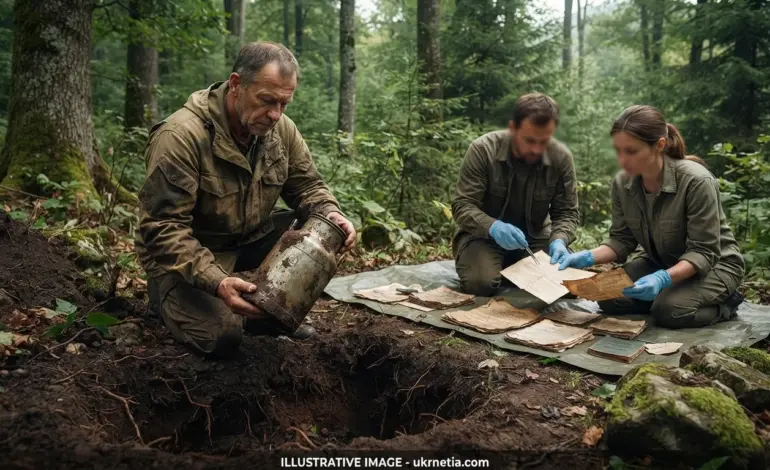

- A sealed metal canister containing an archive of the Bilsivtsi regional OUN underground organization was discovered in a forest near Stari Skomorokhy in Ivano-Frankivsk region.
- The documents had remained underground for nearly 80 years, with most dating from 1948–1949.
- The discovery was made accidentally when a local resident caught his foot on a wire while walking through the forest.
- The archive contains propaganda leaflets, appeals, historical brochures, documents concerning the underground’s finances and materials connected with the OUN Security Service.
- Researchers believe the collection may have belonged to the leader or deputy leader of the Bilsivtsi regional OUN organization because it contains documents from several different underground departments.
- The materials have now been transferred to specialists at the Ivano-Frankivsk Regional Museum of the Liberation Struggle for detailed study and preservation.
A chance discovery in a forest in western Ukraine has uncovered an OUN underground archive that had remained buried for almost eight decades. The collection offers historians a rare look at the activities and internal organization of the Ukrainian nationalist underground in the late 1940s.
A Metal Canister Hidden Underground for Almost 80 Years
A local resident has discovered a sealed metal canister containing historical documents belonging to the Bilsivtsi regional organization of the Organization of Ukrainian Nationalists (OUN) in Ivano-Frankivsk region.
The discovery was made in a forest near the village of Stari Skomorokhy.
Most of the documents date from 1948 and 1949, meaning they had remained underground for almost 80 years.
The Discovery Happened by Accident
The find was made by Andrian Shahan, a resident of the nearby village of Zahirya.
According to the museum and Suspilne, he was walking through the forest when his foot accidentally caught on a piece of wire.
Instead of simply moving on, he decided to investigate the area.
Beneath a layer of soil, he discovered a sealed metal canister.
What Was Inside the Canister?
The container held a collection of historical documents from the Ukrainian nationalist underground.
The majority belonged to the Bilsivtsi district OUN organization and were produced in the late 1940s.
The collection is particularly valuable because it appears to contain material from several different areas of underground activity.
Propaganda Leaflets and Appeals
A significant part of the archive consists of propaganda material.
Researchers found leaflets and appeals addressed to different groups of people.
Among them were appeals directed at Ukrainians serving in the Soviet Red Army, calling on them not to fight against their own people.
Other documents addressed representatives of different peoples living within the Soviet Union.
Brochures About Ukrainian History
The archive also contains brochures dealing with Ukrainian history.
According to researchers, these publications were part of the underground’s broader propaganda and political activity.
They sought to present a historical narrative different from the official Soviet interpretation that dominated public life at the time.
Documents About Financing the Underground
The collection is not limited to political and propaganda materials.
Researchers also found documents concerning the economic activities of the OUN underground, including the collection of money to support the Ukrainian nationalist resistance.
These records can provide historians with information about how underground organizations attempted to finance their activities.
Documents From the OUN Security Service
The archive also contains materials connected with the Security Service of the OUN.
This makes the discovery particularly significant because it provides evidence from another part of the underground structure.
Researchers will now need to determine the precise nature and provenance of these documents.
Why Researchers Think the Archive Belonged to a Senior Underground Leader
The collection is unusually diverse.
It contains materials connected with propaganda, finances, organizational activities and security.
Because of this, researchers believe the archive may have belonged to the leader or deputy leader of the Bilsivtsi regional OUN organization.
This remains a preliminary conclusion rather than an established identification of the original owner.
How the OUN Underground Was Organized
Researchers explain that territorial OUN organizations were divided into specialized departments, sometimes referred to as referenturas.
Different structures dealt with different areas of underground activity.
These included:
- economic affairs;
- propaganda;
- organizational and mobilization work;
- military activities.
The newly discovered archive appears to contain material from several of these areas.
Why the Diversity of the Documents Matters
A single collection containing documents from several departments can reveal how an underground organization operated as a system.
Instead of showing only what the organization published publicly, the archive may also provide information about financing, administration and internal structures.
That makes the discovery potentially valuable beyond the individual documents themselves.
The Archive Was Carefully Hidden
The fact that the documents survived for nearly eight decades suggests that the canister was deliberately concealed underground.
During the post-war period, members of the Ukrainian nationalist underground faced intense repression from Soviet authorities.
Hiding documents underground was one way of preventing sensitive material from being discovered.
Why the Late 1940s Were Important
The documents date mainly from 1948–1949.
This was a period when the Ukrainian nationalist underground was still operating against Soviet rule in western Ukraine.
The Soviet authorities were conducting extensive operations against the underground, making the preservation of organizational documents particularly dangerous.
The Archive Survived Because It Was Forgotten
For decades, the location of the hidden container remained unknown.
The surrounding forest changed over time, while the documents remained underground.
The discovery was therefore the result of an accidental encounter rather than a planned archaeological excavation.
Researchers Had to Remove the Materials Carefully
Because the documents had spent decades underground, simply opening the container and handling the papers could have damaged them.
A specialist working group travelled to the location to examine the site and safely remove the archive.
The Documents Need Special Preservation
The archive has now been transferred to specialists at the regional museum.
The materials require careful handling because of their age and the conditions in which they were stored.
Researchers will need to stabilize and preserve the documents before they can be fully studied.
The Museum Will Study the Collection
The Ivano-Frankivsk Regional Museum of the Liberation Struggle named after Stepan Bandera is now working with the materials.
Specialists have begun detailed examination of the documents.
The museum says it plans to publish initial research findings and provide more information about the archive later.
What Historians May Learn From the Discovery
The archive could provide information about several aspects of underground activity.
Researchers may be able to reconstruct:
- how the local OUN organization was structured;
- how it communicated with the population;
- how it raised funds;
- how propaganda was produced and distributed;
- how different underground departments operated.
It Could Also Reveal Local History
The documents originated from the Bilsivtsi regional organization.
That gives them particular importance for understanding the history of western Ukraine at the local level.
National histories often focus on major leaders and large-scale events, while local documents can reveal how political and underground activity actually functioned in individual communities.
The Documents Were Created Under Soviet Rule
The late 1940s were a period of Soviet consolidation in western Ukraine.
Political opposition and underground nationalist activity were heavily suppressed.
Producing and distributing anti-Soviet material could have serious consequences.
The Archive Shows the Importance of Information
For an underground movement, printed material was an important way of communicating.
Leaflets and appeals could reach soldiers, local residents and other groups.
The discovery therefore provides evidence of the information campaign conducted alongside the underground’s other activities.
Appeals to Red Army Soldiers
One of the particularly notable categories consists of appeals to Ukrainians serving in the Soviet military.
The documents called on Ukrainian soldiers not to act against their own people.
Such material illustrates how the underground attempted to influence Ukrainians who had become part of the Soviet military system.
Appeals to Other Soviet Peoples
The collection also includes appeals directed at other peoples subjected to Soviet rule.
This indicates that the underground’s propaganda was not exclusively aimed at ethnic Ukrainians.
Researchers will be able to examine how these appeals framed the political struggle and what messages they sought to communicate.
The Archive Is Also an Economic Record
The financial documents are potentially just as important as the propaganda material.
An underground movement needs money to operate.
Records concerning fundraising can help historians understand how resources were collected and distributed.
A Rare Look Inside an Underground Organization
The combination of documents makes the discovery particularly interesting.
Rather than being a single publication or isolated leaflet, the collection appears to represent several dimensions of organizational activity.
That is why researchers believe it may have belonged to a senior figure.
Similar Discoveries Have Been Made Before
This is not the first time that an underground archive has been found buried in the forests of western Ukraine.
In April 2025, another metal canister was discovered near the village of Kozakivka.
It contained at least 50 OUN and UPA publications dating from 1948–1950.
Why Underground Archives Keep Appearing
The practice of hiding documents underground was connected to the conditions in which the Ukrainian underground operated.
Documents could expose organizational structures, contacts and activities.
Concealing them in sealed containers offered a chance of preserving them while preventing Soviet authorities from finding them.
The 2025 Discovery Was Also Nearly 80 Years Old
The earlier archive found near Kozakivka had also spent approximately eight decades underground.
Those materials included propaganda publications, appeals to different Soviet peoples and documents written in both Ukrainian and Russian.
They were subsequently transferred for restoration.
Why Metal Containers Were Used
Metal milk or food containers provided a relatively practical way to protect paper materials from moisture and soil.
Sealing the container could slow the deterioration process.
The survival of these documents demonstrates how effective such hiding methods could sometimes be.
But Underground Preservation Is Not Perfect
Even sealed containers cannot completely stop deterioration over many decades.
Temperature changes, humidity and corrosion can affect both the container and the paper.
That is why specialists must treat the newly discovered documents carefully.
The Archive Is More Than a Historical Curiosity
For researchers, the discovery represents a primary historical source.
Unlike later books or recollections, the documents were produced by people involved in the underground at the time.
They can therefore provide direct evidence of what the organization was producing and distributing.
Historians Still Need to Establish the Provenance
Although researchers have a preliminary theory about who owned the archive, the identification is not final.
The contents themselves will need to be examined in detail.
Names, organizational references, dates and other clues could help establish where the documents came from and who was responsible for them.
The Contents Could Help Reconstruct the Local Underground
If enough internal references survive, researchers may be able to connect the documents with specific people and structures.
This could expand knowledge of the underground in the Bilsivtsi area.
The Discovery Connects Material Culture With Written History
The rusty canister itself is an artifact of the period.
Inside it are written records.
Together, the physical container and its contents tell a story about how people attempted to preserve information during a period of political repression.
Why This Matters for Modern Ukraine
Ukraine’s 20th-century history was shaped by competing political systems, occupations and struggles for independence.
Many documents from underground organizations were destroyed, confiscated or lost.
Every surviving collection can therefore help fill gaps in the historical record.
A Different Kind of Historical Discovery
This was not a spectacular archaeological site or an ancient artifact.
It was an ordinary-looking metal container hidden beneath a forest floor.
Its significance comes from what it contained and from the circumstances in which those materials were created and preserved.
The Forest Preserved a Snapshot of 1948–1949
For almost 80 years, the archive remained physically separated from the changing political world above it.
Inside were documents reflecting the concerns, organization and propaganda of the Ukrainian nationalist underground at a particular moment in history.
The Archive Could Expand the Historical Record
The researchers’ future work will determine how much new information the collection contains.
Some documents may duplicate material already known to historians.
Others could contain previously unknown names, instructions, appeals or organizational details.
The Research Has Only Just Begun
The museum has not yet published a complete catalogue or detailed analysis of the archive.
That means it is too early to draw final conclusions about everything the collection can reveal.
The initial information provides only a picture of its broad contents and possible provenance.
Why the Public Will Have to Wait
Historical documents that have spent decades underground cannot always be made public immediately.
They may require cleaning, stabilization, restoration, cataloguing and digitization.
Only after that process can researchers safely publish them.
The Discovery Was Made by a Local Resident
The story also demonstrates the role that ordinary people can play in preserving history.
A chance discovery by a person walking through a forest brought the archive to the attention of historians.
Without that discovery, the documents might have remained underground for decades longer.
The Archive May Become Part of Ukraine’s Cultural Heritage
Once properly studied and preserved, the documents can become an important part of the country’s historical collections.
They may eventually be exhibited or digitized for researchers and the public.
What Happens Next
Museum researchers will continue examining and preserving the documents.
They are expected to publish initial findings and provide more information about the archive once the material has been studied.
The most important questions will concern the identity of its original owner, the exact chronology of the documents and what they reveal about the Bilsivtsi OUN organization.
A Forgotten Archive Returns to History
Nearly 80 years after someone sealed the documents in a metal container and buried them in a forest, the archive has returned to the hands of historians.
The discovery near Stari Skomorokhy offers a rare opportunity to examine original materials from the Ukrainian underground of the late 1940s — not through later recollections, but through documents produced by the organization itself.
For now, researchers are only beginning to uncover what the hidden archive can tell them about one of the most difficult periods in western Ukraine’s modern history.