
The war that began in February 2022, when Ukraine was invaded by Russia, has brought into sharp relief the dynamics of power, solidarity and moral responsibility in the contemporary international system. From one vantage point, Ukraine is a relatively small state, out-matched in conventional strength by its larger neighbour. Yet it has resisted, with zeal, with national will, with support from some Western states, and in so doing it poses a profound challenge to the world’s moral and strategic complacency. Drawing on the metaphor of a “street fight” — in which a tougher, stronger bully is beating up a smaller but spirited individual, while onlookers, though physically capable, remain passive — I argue that the conflict illustrates how the West’s ambivalent behaviour undermines normative leadership, weakens its deterrence posture, and risks normalising impunity for aggression. Ukraine’s struggle thus becomes not just a bilateral war, but a test of the international order and the commitments of stronger states to act.
Ukraine as the Smaller Fighter, Russia as the Tougher Opponent
Ukraine’s position in this war is characterised by an asymmetry of conventional power. Russia, with its larger population, greater military resources and more extensive strategic depth, represents the tougher adversary. Ukraine, comparatively smaller and less resourced, nonetheless has displayed robust resistance, motivated by national survival, identity and the defence of its sovereignty. From 2014 onwards — with the annexation of Crimea and conflict in Donbas — Ukraine began to prepare for this possibility; the full-scale invasion in 2022 turned that into a war of existential stakes. Scholars analysing this war from the structural realist perspective note the significance of power asymmetries and the strategic choices of states in such systems. Repository of the Jagiellonian University
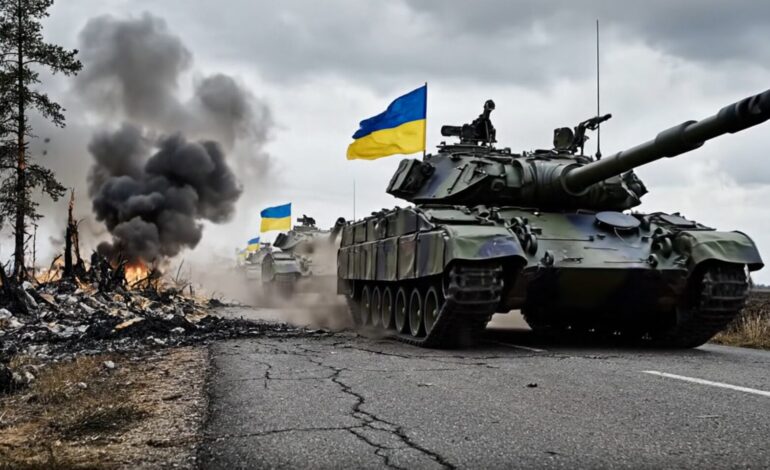
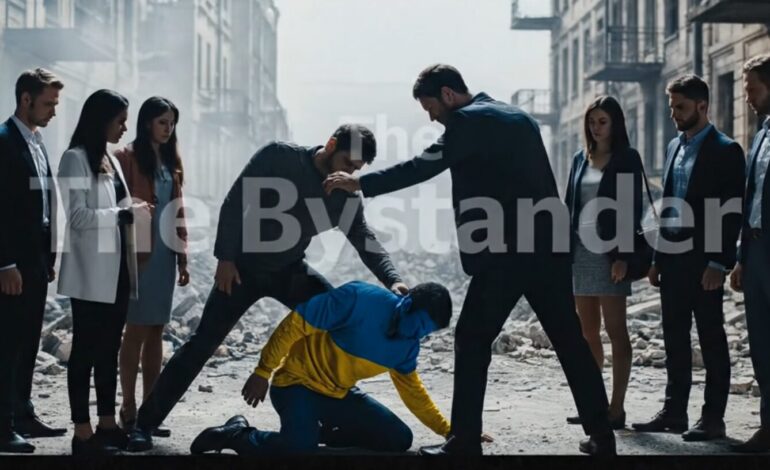
In the street-fight analogy: Ukraine is the smaller fighter, aware of its weaker position, yet willing to fight; Russia is the tougher fighter, ready to impose its will. Yet what complicates the analogy is the role of third parties — the stronger neighbours, the bystanders, the states who are physically capable of intervening but are choosing to watch, or provide limited assistance.
The Role of the Onlookers: Western States as Bystanders
In our analogy, the “rest of the guys on the street” are states in the West (and other global powers) who possess greater collective power than the smaller fighter (Ukraine) and in many respects than the bully (Russia). If they choose to intervene decisively, they could tilt the balance; their non-intervention or limited intervention sends a symbolic message. The war in Ukraine reveals that despite rhetorical commitments to sovereignty, democracy and deterrence, many Western states have been reluctant to commit fully — especially in direct force. This hesitation has several manifestations: delays in heavy weapons delivery, caution in escalation, and divided domestic politics about the extent of involvement. SpringerLink
The metaphor is potent: imagine a strong adult watching a bully assault a smaller child, and instead of intervening, says, “Please stop,” or holds back because of fear of escalation — the bully interprets that as weakness, the child as abandonment, and the onlooker as morally compromised. In geopolitical terms, the bully (Russia) reads Western caution as a signal that costs of aggression are manageable; the smaller fighter (Ukraine) reads it as solidarity in words but not in full substance; and global audiences see a weakening of normative order.
Implications for Norms, Credibility and the International Order
The consequences of this bystander dynamic are multi-layered. First, from the normative perspective: when stronger states do not act decisively in defence of a weaker state facing aggression, the principle of the inviolability of borders and sovereignty is weakened. This sets a precedent: if stronger states watch while a weaker one is attacked, aggressors may be emboldened. Some scholars argue that the West’s moral emotions — guilt and shame over past failures — have driven its response, but also led to inconsistent policies. OUP Academic
Second, from the credibility/deterrence perspective: deterrence is not simply about possessing capability but signalling credible willingness to use it. When Ukraine asks for serious military support and response is delayed or partial, the signal to Russia (and other potential aggressors) is that the West may not fight hard, even though it can. This undermines the posture of those onlookers as reliable guarantors. The book The West’s Response to the Ukraine War details the military, political and normative challenges of this dynamic. SpringerLink
Third, from the practical solidarity perspective: supporting Ukraine is not just symbolic; it has strategic significance. Some analyses suggest that Russia’s strategy has been to “globalise” the war — to press the West through multiple fronts (energy, food, alliances) and test its resolve. Foreign Affairs If the Western bloc persists in half-measures, the bully wins by default.
Why the Western States Hesitate: Costs, Risk, and Domestic Politics
Why do stronger states hesitate? Several factors: risk of escalation, internal domestic war fatigue, opportunity costs, alliance coordination difficulties, and concerns about mission creep. In our analogy, the bystanders might fear getting punched themselves if they intervene, or fear the fight dragging on. The West is aware that direct intervention risks confrontation with Russia. The strategic ambition of containing Russia may be tempered by concerns about nuclear escalation, economic blowback, refugee flows and long-term entanglement.
Moreover, the smaller fighter (Ukraine) fights with enthusiasm, valor and moral legitimacy, but lacks the capacity to win outright without sustained support. The onlookers may feel that giving limited help is sufficient or that an early negotiation is preferable to full-scale involvement. Here lies a critical fault line: if the smaller fighter is left to fight alone for too long, the onlookers’ moral credibility erodes and the bully advances.
The Street-Fight in Practice: Ukraine’s Endurance and Western Reticence
In practice, Ukraine has demonstrated resilience beyond what many expected. But it is fighting an exhausting war — not just of bullets, but of morale, logistics, sustaining international support. The metaphor of a spirited but battered smaller fighter is appropriate: he keeps rising and throwing punches; yet his endurance depends on help. Meanwhile the world watches — some cheer, some supply a bit of food or water, but few roll up their sleeves fully. The problem is compounded when the bully receives external backing (Russia’s alliances, arms imports, proxy forces) or when the onlookers’ support is conditional and slow.
For example, Western provision of arms, financial aid and training has been substantial yet appears calibrated to avoid full-scale direct engagement; this conveys to the bully that escalation beyond a certain threshold may still pass unchallenged. Some research into Western media framing indicates that public discourse in Britain and the U.S. sometimes portrayed Ukraine’s cause as noble but remote, contributing to a certain psychological distance. De Gruyter Brill
The Consequences of Impassivity: Encouraging the Bully and Abandoning the Smaller Fighter
If the bystanders continue to refrain from decisive support, the bully wins essentially by attrition and intimidation. Each incremental victory reinforces his belief in impunity, making future aggression easier. The smaller fighter, though courageous, risks being worn down and possibly forced into a settlement that undercuts his sovereignty. For the onlookers, the risk is both moral and strategic: if their joint posture is seen as weak, this damages their ability to deter future aggression elsewhere.
In the real world, actors such as China, Iran and North Korea observe this fight: if the stronger states will not act when a smaller one is being beaten, what signal does that send about the order’s protections? The analogy becomes stark: the bully is being cheered on quietly, the spectator states are shrugging or leaving.
Reversing the Bystander Dynamic: What Stronger States Must Do
To change the narrative — to avoid the bystander scenario — stronger states must do more than watch or verbally condemn. They must provide tangible, credible support: arms, logistics, intelligence, alliance coordination, and readiness to escalate the cost for the bully if the smaller fighter is attacked. In the street-fight metaphor, the strong adults must step in visibly, signal they will stop the bully, and change the calculus.
The moral dimension is also important: when a weaker actor is defending core principles like sovereignty, democracy and human rights, supporting them isn’t merely altruism; it reinforces the rules-based order. The article “Making amends: emotions and the western response to Russia’s invasion of Ukraine” argues that guilt and shame led some Western states to act, but the resultant policies remain uneven. OUP Academic
In the concluding phase, a credible deterrence posture means that the smaller fighter is backed such that the bully calculates higher costs. The bystanders thereby shift from onlookers to guarantors.
Final thoughts
The war in Ukraine is more than a bilateral clash; it is a mirror of global order, responsibility, and the power of choice by stronger states. The analogy of a tougher bully beating a smaller fighter while capable bystanders watch highlights the moral and strategic tension facing the West. Ukraine’s fight is heroic, but it is also indicative of what happens when a weaker actor is left to bear the brunt of aggression alone.
If stronger states continue to watch rather than intervene meaningfully, the message is clear: aggression can succeed if the price is manageable and the bystanders passive. Conversely, if stronger states act decisively — signalling that assistance to the smaller fighter is robust, credible and sustained — then the order they claim to uphold retains force. Thus, the street-fight analogy becomes a call to action: the world cannot afford to be mere spectators.
In the end, for Ukraine, for the West, and for the international system, the question is: who steps in? Who watches? And what future will the onlookers allow? And’ll have for themselves by being passive?