How Does Ukraine’s Political System Work? A Guide to Government, Parliament and the President


Understanding how Ukraine is governed is essential for anyone interested in the country’s politics, society, economy, or future in Europe. At first glance, the system can seem complicated because political power is divided between the President, Parliament, the Government, the courts, and local authorities.
Ukraine is a republic based on the separation of legislative, executive, and judicial power. The Constitution establishes the basic structure of the state and defines the powers of its principal institutions.
For international readers, the easiest way to understand the system is to look at the different institutions and the roles they play.
Ukraine Is a Republic With a Mixed Political System
Ukraine is constitutionally a republic rather than a monarchy. The people are recognized as the source of state power, which they exercise directly and through state authorities and local self-government.
The Constitution divides state power into three branches:
- legislative power — exercised by Parliament;
- executive power — exercised by the Government and other executive bodies;
- judicial power — exercised by the courts.
The President occupies a separate and important constitutional position as the head of state.
This means that Ukraine is not a system in which the President personally controls every part of government. Different institutions have different constitutional responsibilities.
The President: Head of State
The President of Ukraine is the head of state and represents Ukraine internationally.
The Constitution describes the President as the guarantor of state sovereignty, territorial integrity, the Constitution, and citizens’ rights and freedoms. It also gives the President a specific role in Ukraine’s strategic course toward full membership of the European Union and NATO.
The President is elected directly by Ukrainian citizens for a five-year term.
Among the President’s constitutional responsibilities are important areas of foreign policy, national security and defense, appointments to certain state positions, and relations with other branches of government.
The President can also veto laws adopted by Parliament, although Parliament can reconsider legislation under the procedure established by the Constitution.
The President also chairs the National Security and Defense Council, a coordinating body dealing with national security and defense issues.
The Verkhovna Rada: Ukraine’s Parliament
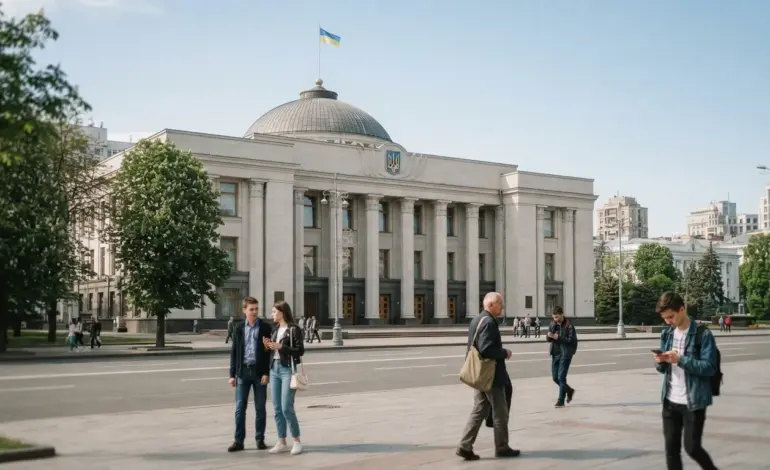
The Verkhovna Rada of Ukraine is the country’s sole legislative body.
Its constitutional composition is 450 members, known as people’s deputies, who are elected for five-year terms. Parliament adopts laws, approves the state budget, exercises parliamentary oversight, and performs a number of other constitutional functions.
Parliament is therefore much more than a place where politicians debate legislation.
The Verkhovna Rada also plays a major role in forming the Government and overseeing its work.
It approves the Prime Minister and members of the Cabinet according to the constitutional appointment procedure. It can also consider the Government’s responsibility and exercise parliamentary control over the executive branch.
How Parliament Makes Laws
A proposed law can go through several stages before becoming legislation.
Parliamentary committees examine bills, deputies debate them, amendments can be proposed, and the full Parliament eventually votes.
The Constitution provides that laws and other parliamentary acts are adopted by voting at parliamentary sessions, with the required majority depending on the particular constitutional provision.
This process means that legislation is not simply created by the President or the Government.
The Prime Minister and the Cabinet of Ministers
If the President is the head of state, the Prime Minister is the head of the Government.
The Cabinet of Ministers is the highest body in Ukraine’s system of executive power.
The Prime Minister directs the work of the Cabinet and coordinates the implementation of the Government’s program approved by Parliament.
The Cabinet includes:
- the Prime Minister;
- the First Deputy Prime Minister;
- Deputy Prime Ministers;
- ministers responsible for particular areas of government policy.
The Prime Minister is appointed by Parliament following the constitutional nomination procedure. The President submits the candidate based on a proposal from the parliamentary coalition or the parliamentary faction that has the majority of constitutional composition, as provided by the Constitution.
The President also submits candidates for the Ministers of Defense and Foreign Affairs, while other ministers are appointed by Parliament on the Prime Minister’s submissions.
This division is important because it demonstrates why Ukraine’s Government cannot simply be described as an extension of the President.
What Does the Government Actually Do?
The Cabinet of Ministers is responsible for the practical administration of the country.
Its constitutional responsibilities include economic, financial, tax, social, educational, scientific, cultural, environmental, and employment policies.
The Government also prepares the draft state budget, organizes its implementation after Parliament approves it, coordinates ministries and other executive authorities, and takes measures related to national security and defense.
In everyday terms, the Government is responsible for turning laws and national policies into functioning public administration.
A simple way to think about the division is:
Parliament makes laws and exercises oversight.
The Government implements policy and runs the executive administration.
The President represents the state and has constitutionally defined powers, particularly in foreign affairs, defense, and national security.
The actual relationship between these institutions is more detailed, but this provides a useful starting point for understanding the system.
The Judiciary: An Independent Branch of Power
The third major branch of state power is the judiciary.
Ukraine’s Constitution establishes the separation of legislative, executive, and judicial power. Courts are therefore not subordinate departments of either the President, Parliament, or Government.
The judicial system deals with disputes, criminal cases, administrative matters, and other issues defined by law.
Ukraine also has the Constitutional Court, which has a specific role in constitutional matters and is separate from the ordinary court system.
For international readers, the important point is that Ukrainian courts form an independent branch of state power rather than functioning as another part of the executive government.
Local Government Matters Too
Political power in Ukraine is not concentrated entirely in Kyiv.
The Constitution recognizes and guarantees local self-government. At the local level, territorial communities exercise authority directly and through elected local councils and their executive bodies.
The system includes:
- territorial communities;
- village, settlement, and city councils;
- village, settlement, and city mayors;
- executive bodies of local councils;
- district and oblast councils representing the common interests of local communities.
Local authorities are responsible for many issues affecting everyday life, including local infrastructure, municipal property, local budgets, and public services within their legal powers.
Ukraine’s decentralization reform significantly strengthened the role of territorial communities, making local government an important part of the country’s political system.
How the Main Institutions Work Together
The easiest way to understand Ukraine’s political system is to think of it as a network of institutions rather than a hierarchy with one person at the top.
A simplified model looks like this:
Ukrainian citizens
↓ elect
President + Parliament + local authorities
↓
Parliament — makes laws and oversees the Government
President — head of state, with defined constitutional powers
Government — manages executive administration
Courts — exercise judicial power
Local authorities — manage local matters within their legal powers
These institutions interact with one another and, in many cases, require each other’s participation before important decisions can take effect.
What Changes During Wartime?
Ukraine’s political system has also had to operate under extraordinary conditions since the introduction of martial law following Russia’s full-scale invasion.
Martial law does not simply abolish the constitutional system. Instead, Ukrainian legislation establishes a special legal regime under which certain rights may be restricted and additional powers can be exercised according to law.
One important consequence concerns elections. Ukrainian law prohibits presidential, parliamentary, and local elections while martial law is in effect. The Constitution also provides that if the term of the Verkhovna Rada expires during martial law or a state of emergency, its powers continue until the first meeting of the newly elected Parliament after the relevant regime ends.
This is an important distinction for international observers: the continuation of Parliament during wartime is provided for within Ukraine’s constitutional framework rather than representing the permanent abolition of elections.
Why Ukraine’s Political System Can Seem Complicated
Ukraine’s system has changed significantly since independence in 1991.
The balance between presidential and parliamentary powers has shifted several times through constitutional amendments and political changes. As a result, explanations based on older descriptions of Ukraine can sometimes be misleading.
The current constitutional framework gives important responsibilities to both the President and Parliament, while the Prime Minister and Cabinet manage the executive branch.
At the same time, local government has become increasingly important following decentralization.
This makes Ukraine’s political system more accurately understood as a system of checks, shared responsibilities, and institutional interaction rather than a simple presidential model.
Looking Ahead
Understanding Ukraine’s political system requires looking beyond individual politicians.
Presidents change. Parliamentary coalitions change. Governments are replaced. But the underlying institutions continue to define how political power is exercised.
The President represents the state and has important constitutional responsibilities in foreign affairs, defense, and national security. The Verkhovna Rada makes laws, approves the budget, and exercises parliamentary oversight. The Cabinet of Ministers manages executive government, while courts exercise judicial power. Local councils and communities handle many matters closer to everyday life.
For anyone trying to understand modern Ukraine, this institutional structure is more important than memorizing the names of individual politicians.
It provides the framework through which the country makes decisions, responds to crises, manages public services, and continues its political development as a European democracy.