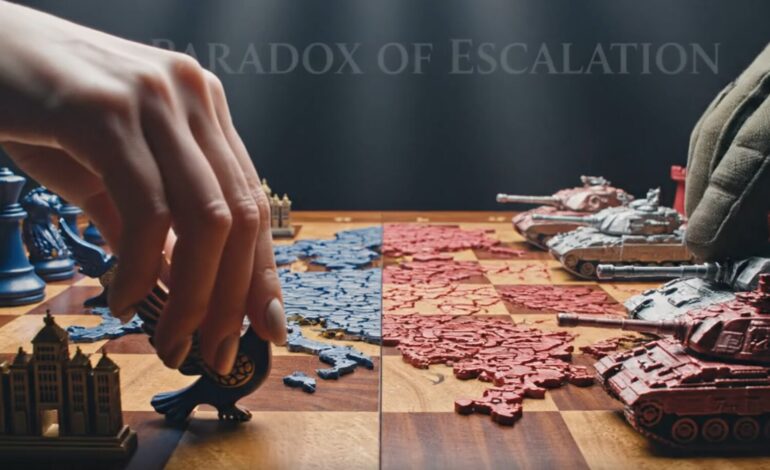
The Paradox of Escalation: How Western Restraint Fuels Russian Aggression

In late 1930s Europe, the policy of appeasement pursued by the major powers toward Adolf Hitler’s Germany stands as an enduring cautionary tale: the stronger hesitated to challenge the stronger aggressor, hoping to avoid escalation, and instead provoked further expansion (Haslam, 2024). In the contemporary conflict between Ukraine and Vladimir Putin’s Russia, a comparable dynamic is at play. Western states, worried that supplying the weapons Ukraine needs will trigger a dramatic escalation by Russia, often delay or limit assistance. Yet evidence suggests that this very restraint signals weakness rather than caution: it emboldens Putin’s aggression, increases the likelihood of escalation, and ironically undermines the very stability the West claims to protect. On the contrary, decisive arms support to Ukraine can act not as a trigger of escalation but as a means of deterrence, lowering the risk of further aggression.
This essay argues three inter-linked propositions. First, that fear of escalation by Western states often leads them to withhold vital military support from Ukraine, under the assumption that restraint will reduce the risk of a broader conflict. Second, that this assumption is flawed: when an aggressor such as Russia perceives weakness either in its target or in the bystander’s will, it has a greater incentive to escalate. Third, that stronger and timely support for Ukraine — rather than provoking escalation — can actually reduce it by shifting the aggressor’s cost-calculus and signalling credible deterrence.
Fear and Restraint: Western States in Apprehension Mode
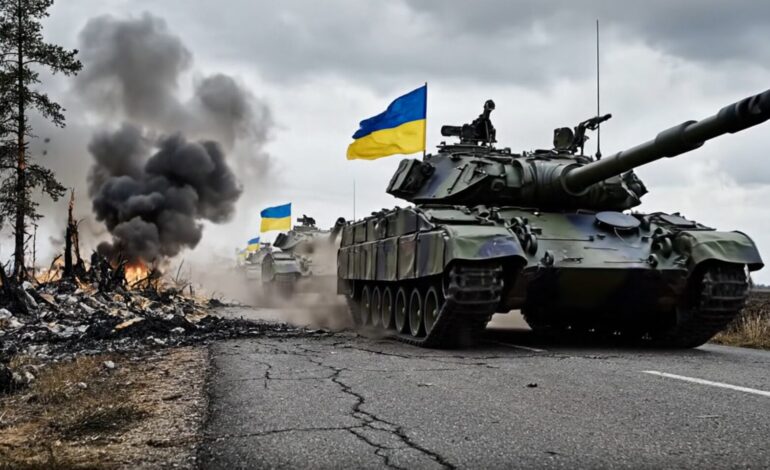
From the outset of Russia’s full-scale invasion of Ukraine in February 2022, Western governments have faced a dual dilemma: the moral imperative to assist Ukraine in its defence, and the strategic fear of causing a broader war or triggering Russian nuclear escalation. Scholars note how Russia has consistently leveraged nuclear rhetoric and strategic ambiguity to constrain Western military assistance (Nimark, 2022). For instance, in the early months of the war, many Western arms transfers to Ukraine were deliberately calibrated: major offensive systems were withheld, and ground-rules around escalation were tacitly observed (Allison, 2025).
This cautious posture reflects a logic common to decision-makers: by not supplying Ukraine the most aggressive weaponry, the West hopes to maintain a safe buffer that avoids provoking Russia. The implicit reasoning: if the bully’s challenge remains costly and limited, then escalation may be avoided. But this logic resembles the flawed rationale of appeasement: by avoiding confrontation, the stronger side allows the aggressor to continue unchecked.
Crucially, the problem is not simply the absence of action, but the signal that absence sends. When Ukraine requests heavy weapons and is told “we’ll think about it” or “we don’t want to provoke escalation,” the message to the aggressor is: “we lack the will to act decisively.” That perception of weakness invites further aggression. It echoes the street analogy: if a bystander watching a bully assault a smaller person remains passive, the bully interprets that passivity as permission.
Weakness Invites Escalation: The Bully’s Perspective
The logic of aggression — especially for a revisionist state like Russia — hinges on incentives. When target states or external backers demonstrate credible deterrence, aggression becomes costly. When they do not, the aggressor sees opportunity. As Timtchenko (2022) observes, providing Ukraine with heavy weapons is not escalation—it is deterrence; failure to provide them invites escalation. From the bully’s viewpoint, the calculus is clear: if the victim and onlookers appear ready to resist, the aggressor must be cautious; if they appear passive, the aggressor has a green light.
In this conflict, Putin’s Russia behaves akin to a “street hooligan”: public threats, manufactured red-lines, and repeated probing attacks against Ukraine and its infrastructure. If the West hesitates, the aggressor gains license to escalate in measured steps. Sinovets, Maksymenko & Skrypnyk (2021) highlight that Russia’s doctrine of “escalation for de-escalation” is less about nuclear first use and more about exploiting perceived weakness in conventional domains. The more that strength is deferred or denied, the more the aggressor perceives reward from action.
Moreover, the fear of escalation itself becomes a self-fulfilling prophecy: by refusing to equip Ukraine adequately, Western states implicitly lower the cost of further Russian escalation. Russia then may choose to escalate precisely because the cost remains manageable. Rather than being deterred, the aggressor is encouraged. In this sense, hesitation becomes enabling.
Strength as Deterrence: Arming Ukraine to Avoid Escalation
Contrary to the widespread view that supplying major weapon systems increases risk of escalation, a growing body of analysis suggests the opposite: credible support can reduce escalation by altering the aggressor’s calculations. Allison (2025) argues that during 2022-2025 Western powers adopted a combined strategy of threats and restraint, but that over-cautiousness in Germany, the UK and the US allowed Russia to “subvert the Ukrainian state and the European security order.”
Timtchenko (2022) frames providing Ukraine heavy equipment as deterrence, not provocation. When Ukraine is equipped to take the fight to Russia’s proxies, and when Western alliance support is visible and credible, Putin must weigh higher costs for each act of aggression. The logic of armed resistance becomes the logic of deterrence: the bully stops when the victim can effectively hit back, and when the onlookers signal they will respond. This parallels the street-fight metaphor: the weaker victim does not survive by begging the bully to stop; he survives by demonstrating capacity to defend and appealing to stronger bystanders who will enforce consequences.
Empirically, the delay in major Western systems entering Ukraine raised concerns. As Allison (2025) shows, the first three years witnessed incremental, cautious arms flows, and in that timeframe Russia achieved significant gains. Thus, one might argue that earlier, bolder support could have reversed momentum and reduced the duration and intensity of war. The longer the victim fights un-equipped, the greater the humanitarian, economic and strategic cost, and the more emboldened the aggressor becomes.
Historical Parallel: Appeasement and Its Lessons
The interwar period provides a cautionary reference. The Munich Agreement of 1938 is often cited as the archetypal failure of deterrence through appeasement: major powers hoped that limiting demands would placate Hitler, but instead emboldened him to take Czechoslovakia and then invade Poland in 1939. The logic held: “we don’t want war” → “let’s negotiate” → “he takes bigger bites.”
Today, the West’s refusal to equip Ukraine fully in the name of avoiding escalation echoes that pattern. By signalling willingness to tolerate limited aggression, the harsher aggression becomes more likely. What Germany and Britain experienced then, Europe in Ukraine faces now: a strong aggressor interpreting hesitancy as weakness, and a system of states watching while sovereignty is eroded. The lesson: deterrence must be credible, and strength must be shown.
Addressing the Counter-Argument: What About the Risk of Wider War?
Critics will argue that supplying Ukraine heavy weapons increases the risk of escalation—to NATO direct conflict or even nuclear exchange. Nimark (2022) and van Hooft, Ellison & Sweijs (2023) highlight this risk: Russia’s nuclear rhetoric and threat posture remain active, and any perceived step across a red line could trigger panic. Indeed, the war in Ukraine has seen nuclear threat-signalling as part of Russia’s strategy (Nimark, 2022).
However, this line of reasoning overlooks a central issue: the risk of not acting. The Western fear of escalation becomes a rationalisation for inaction, but as Allison (2025) argues, the restrained support enabled Russia to undermine Ukraine’s defence and the European security order — thereby increasing medium-term escalation risk. A strong, well-armed Ukraine reduces escalation pressure by raising the cost of further aggression. Weakness invites, strength deters.
Moreover, credible deterrence does not require recklessness. Arms transfers can be calibrated, communicated, and supported through alliance coordination such that escalation risks are managed. The key is not abstinence, but credible readiness. In the street metaphor: calling the bully out without backing it up encourages the bully to continue; however, preparing to intervene and signalling that intervention will happen if necessary changes the bully’s calculus.
Strategic Implications for Western Policy
Based on this logic, several strategic implications emerge for Western policymakers:
-
Equip Ukraine with the tools to impose credible costs on Russia. Delaying or withholding heavy weaponry sends a message of vulnerability.
-
Signal alliance unity and resolve. The aggressor watches not just the arms, but the network behind them. A united front reduces opportunities for escalation.
-
Avoid the illusion that restraint is safer. Appeasing or delaying support in fear of escalation may produce more escalation, not less.
-
Frame support as deterrence, not escalation. The narrative matters: heavy weapons are not an act of adventurism, but a reinforcement of the rules-based order.
-
Plan for the medium term. A weaker Ukraine—and by extension a weaker Europe—creates a larger vulnerability down the line. Acting now reduces future escalation pressure.
These steps form a coherent strategy: demonstrate that aggression will meet force, that support for Ukraine is not optional, and that the international system retains the will and capacity to defend its principles.
Conclusion
The war in Ukraine has tested the limits of deterrence, alliance solidarity and strategic messaging. The formula is as old as conflict: aggression meets resistance or acquiescence. When it meets resistance, escalation becomes less likely; when it meets acquiescence, escalation becomes more likely. The belief that not arming Ukraine will prevent escalation overlooks this dynamic and instead invites aggression. Far from caution, it is a signal of weakness.
In the street-fight analogy: the smaller fighter is beaten not because the stronger fighter is invincible, but because the larger circle of capable bystanders refuses to act. The bully escalates not when he meets force, but when he perceives passivity. By providing Ukraine the weapons it needs, and by signalling that aggression will be met with resistance, the West can reduce escalation risks. The paradox of escalation is that strength, not weakness, is the truer path to preventing further war.
In short: When the West fears escalation and holds back—and the aggressor sees the fear—that fear becomes the escalation. When the West arms Ukraine credibly and stands firm, escalation becomes less likely because aggression then becomes costlier. The lesson is timeless and clear: deterrence demands strength.
References
Allison, R. (2025). Averting acute escalation in Russia’s war against Ukraine. International Affairs, 101(5), 1769-1791.
Haslam, J. (2024). Hubris: The American origins of Russia’s war against Ukraine. Apollo.
Nimark, A. (2022). Nuclear rhetoric, escalation and risks of miscalculation in Ukraine. CIDOB.
Sinovets, P., Maksymenko, I., & Skrypnyk, M. (2021). The role of escalation strategy in Russia’s aggression. Lithuanian Annual Strategic Review, 19(1).
Timtchenko, I. (2022, September 28). Giving Ukraine heavy weapons is deterrence, not escalation. Belfer Center for Science and International Affairs.
van Hooft, P., Ellison, D., & Sweijs, T. (2023). Strategic stability: Deterrence and arms control—Russia’s war against Ukraine and the risks of inadvertent nuclear escalation. The Hague Centre for Strategic Studies.