Russian Attack Damages Three More Major Ukrainian Publishers in Kyiv


KEY TAKEAWAYS
- Three more Ukrainian publishers — Ranok, Vikhola and BookChef — were damaged during Russia’s August 16 attack on Kyiv.
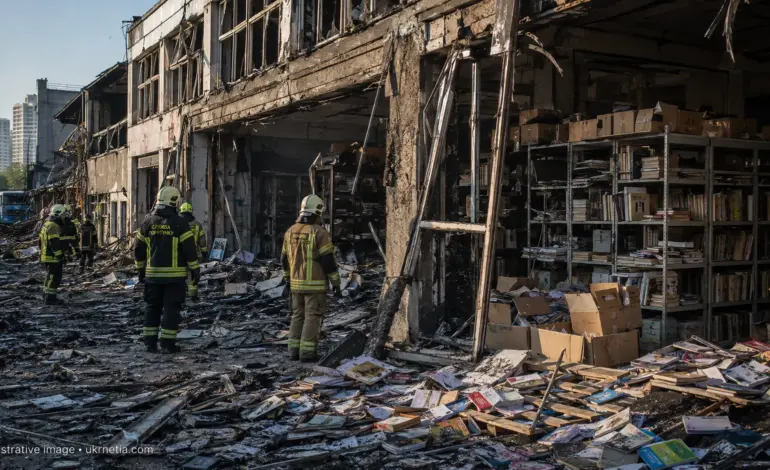
- More than 40,000 books belonging to Ranok were destroyed by fire at a warehouse near Pochaina.
- Vikhola’s warehouse facilities were damaged for the third time, with furniture intended for book islands stored there.
- BookChef reported damage to its office, online-store facade, windows, book storage areas, exhibition photo zone, marketing materials and merchandise.
- Despite the destruction, all three publishers say they intend to continue operating, while BookChef’s online store remains open.
- The latest damage comes after earlier Russian strikes destroyed hundreds of thousands of BookChef books and damaged other Ukrainian publishing companies.
Russia’s August 16 attack on Kyiv caused further damage to Ukraine’s publishing industry, affecting Ranok, Vikhola and BookChef. More than 40,000 Ranok books were destroyed, while warehouses and publishing offices belonging to the other companies were also damaged. Despite the losses, the publishers say they are continuing their work.
More Ukrainian Publishers Hit
The Russian attack on Kyiv in the early hours of August 16 did more than destroy much of the capital’s historic Pochaina book market.
The strike also damaged several publishing companies operating in the area.
Earlier reports identified damage to the offices and warehouses of Laboratoria and Nash Format. New information now shows that Ranok, Vikhola and BookChef were also affected.
The concentration of damage around Pochaina has turned the attack into a particularly serious blow to Kyiv’s publishing and bookselling ecosystem.
More Than 40,000 Ranok Books Destroyed
The most significant loss reported by Ranok concerns its warehouse located at the Alpaka bookstore near Pochaina.
More than 40,000 books burned in the fire following the attack.
Although office equipment survived, the building itself is currently unsuitable for normal operations.
For a publishing company, losing tens of thousands of books at once is not simply a physical loss.
The destroyed inventory can affect distribution, sales, relationships with bookstores and schools, and the availability of particular editions.
Ranok Will Continue Working
Despite the damage, Ranok says it does not intend to stop operating.
Instead, the publisher plans to redistribute workloads, adjust schedules and look for alternative production solutions.
Some processes may have to slow down or be reorganized, particularly logistics and printing.
However, the company says it intends to continue its key projects and meet its commitments to partners, schools and readers.
This is particularly important because Ranok is one of Ukraine’s major educational and children’s publishing companies.
Vikhola’s Warehouse Damaged for the Third Time
The attack also affected warehouse facilities belonging to Vikhola.
The company said the damaged premises contained furniture intended for its book islands and retail locations.
More significantly, this was reportedly the third time these premises had been damaged.
Repeated attacks create a different type of challenge from a single incident.
Businesses are forced to rebuild, relocate or repair their facilities, only to face the possibility that the same infrastructure may be damaged again.
BookChef Office and Warehouse Areas Damaged
BookChef also suffered extensive damage.
The publisher reported broken windows and damage to the facade of its online store, as well as damage to parts of its book storage facilities.
A photo zone that had been prepared for exhibitions was damaged, along with marketing materials and merchandise.
The company’s building also suffered significant roof and facade damage.
Despite this, BookChef’s online store continues to accept, process and ship orders.
BookChef Had Already Lost Nearly a Million Books
The latest damage is particularly significant because BookChef had already suffered enormous losses from previous Russian attacks.
On July 2, the destruction of the central warehouse operated by logistics partner Denka Logistics resulted in the loss of approximately 800,000 books, according to the publisher.
Then, during another Russian attack in early August, a reserve warehouse was hit and more than 100,000 additional books were destroyed.
That means the publishing house has now experienced repeated destruction of its book stocks within a matter of weeks.
The Damage Is Larger Than One Market
The Pochaina area has become a major center of Kyiv’s book trade and publishing logistics.
The August 16 attack destroyed much of the historic book market itself, while also damaging several publishers operating nearby.
This creates a chain reaction.
Bookshops lose inventory. Publishers lose warehouses. Logistics companies lose infrastructure. Distributors face delays.
The consequences can therefore continue long after the fires have been extinguished.
A Blow to Ukrainian Cultural Infrastructure
Books are different from many other commercial goods because their destruction can also mean the loss of cultural and educational material.
A burned warehouse can contain thousands of copies of books that may take months to reprint.
Some editions may also be temporarily unavailable because their printing schedules and distribution networks have been disrupted.
For educational publishers, the consequences can be especially serious when books are intended for schools and students.
Ukrainian Publishing Has Already Faced Repeated Attacks
The latest incident is part of a broader pattern.
Russian attacks have repeatedly hit Ukrainian publishing and printing infrastructure during the full-scale war.
BookChef’s previous losses demonstrate how a company can be forced to rebuild its logistics system and then suffer another strike on the replacement infrastructure.
Other publishers have also reported damaged or destroyed offices, warehouses and printing-related facilities.
The result is an increasingly difficult operating environment for an industry that is already working under wartime economic pressure.
The Pochaina Attack Has Become a Symbol
The destruction around Pochaina has attracted particular attention because the area represents a significant part of Kyiv’s book culture.
The historic market served generations of readers and booksellers.
Its destruction, combined with damage to publishing companies nearby, has created a symbolic image of the war’s impact on Ukrainian cultural life.
The attack did not only damage buildings.
It destroyed books, business inventories and workplaces connected to the production and distribution of Ukrainian literature.
Publishers Are Trying to Adapt
The response from the affected companies has been notably focused on continuity.
Ranok is reorganizing its production and logistics.
BookChef has kept its online store operating.
Vikhola is assessing the damage to its facilities while dealing with yet another attack on the same premises.
Such measures allow the companies to preserve at least part of their operations while reconstruction and replacement facilities are considered.
Readers Can Also Help
BookChef has explicitly encouraged readers to continue buying books from its online store, arguing that every order helps the company maintain operations and recover from the damage.
This highlights an unusual feature of the situation.
For many publishing companies, customers are not simply consumers.
Continued purchases can directly support the cash flow needed to repair facilities, replace inventory and finance new print runs.
A Difficult Road Ahead
The full financial consequences of the August 16 attack are still being calculated.
The physical damage is only one part of the problem.
Publishers must also account for destroyed inventory, interrupted logistics, delayed production, damaged equipment and the cost of finding alternative premises.
For Ranok, the loss of more than 40,000 books alone represents a substantial disruption.
For BookChef, the latest incident comes after losses measured in hundreds of thousands of books during previous attacks.
Ukrainian Books Continue Despite the Damage
The most important message from the affected publishers is that they are not planning to disappear.
Their warehouses can be damaged, books can be destroyed and offices can be forced to close temporarily, but the publishing process can be reorganized.
Alternative warehouses can be found. Books can be reprinted. Online stores can continue operating.
That resilience is becoming a defining feature of Ukraine’s cultural industries during the war.
Russia’s repeated attacks have inflicted major physical and financial losses on Ukrainian publishers, but Ranok, Vikhola and BookChef are continuing to work. Their response demonstrates that the destruction of warehouses and books does not necessarily mean the destruction of Ukraine’s publishing industry — even as the cost of keeping it alive continues to rise.