Slavic Appearance: History, Culture and Regional Diversity


Put a Ukrainian, a Pole, a Czech, a Serb, a Bulgarian, a Slovene and a Belarusian in one room and you will not find a shared face. You will find a continent. Here is why that diversity is not a puzzle to be solved — it is the answer itself.
What does a Slavic person look like? It is one of the most common questions typed into search engines, and it sounds as though it should have a tidy answer — a nose, a cheekbone, a shade of hair, a color of eye. It does not. The moment you try to assemble the checklist, it dissolves in your hands.
Imagine the room again. The Ukrainian might have dark hair and brown eyes; the Belarusian, ash-blond and gray-eyed; the Bulgarian, olive-skinned; the Slovene, fair; the Pole, somewhere in between; the Czech, easily mistaken for a Bavarian; the Serb, easily mistaken for a Greek. Every one of them belongs to a population bound together by Slavic languages and a thousand years of intertwined history. And yet there is no face they all share.
This is the paradox at the heart of the subject, and it is worth stating plainly at the outset: there is no scientifically valid checklist of facial characteristics that defines a Slavic person. What exists instead is something more interesting — a set of historical, geographic and population-level reasons why the very idea of a “Slavic appearance” took hold, and why it keeps its grip even though the science does not support it.
This article takes the question seriously without pretending it has a simple answer. Along the way it draws on population genetics, archaeology, the newest ancient-DNA research, linguistics and the psychology of face perception. The goal is not to hand you a template. It is to replace one question — what does the typical Slavic person look like? — with a better one: why do so many people across such a vast stretch of Europe share a Slavic heritage while looking so different from one another?
First, What Does “Slavic” Actually Mean?
Before we can talk about appearance, we have to be precise about the word. “Slavic” is, first and foremost, a linguistic and historical classification — not a biological one. It describes a family of related languages and the populations who speak them, along with the shared history that spread those languages across a large part of Europe.
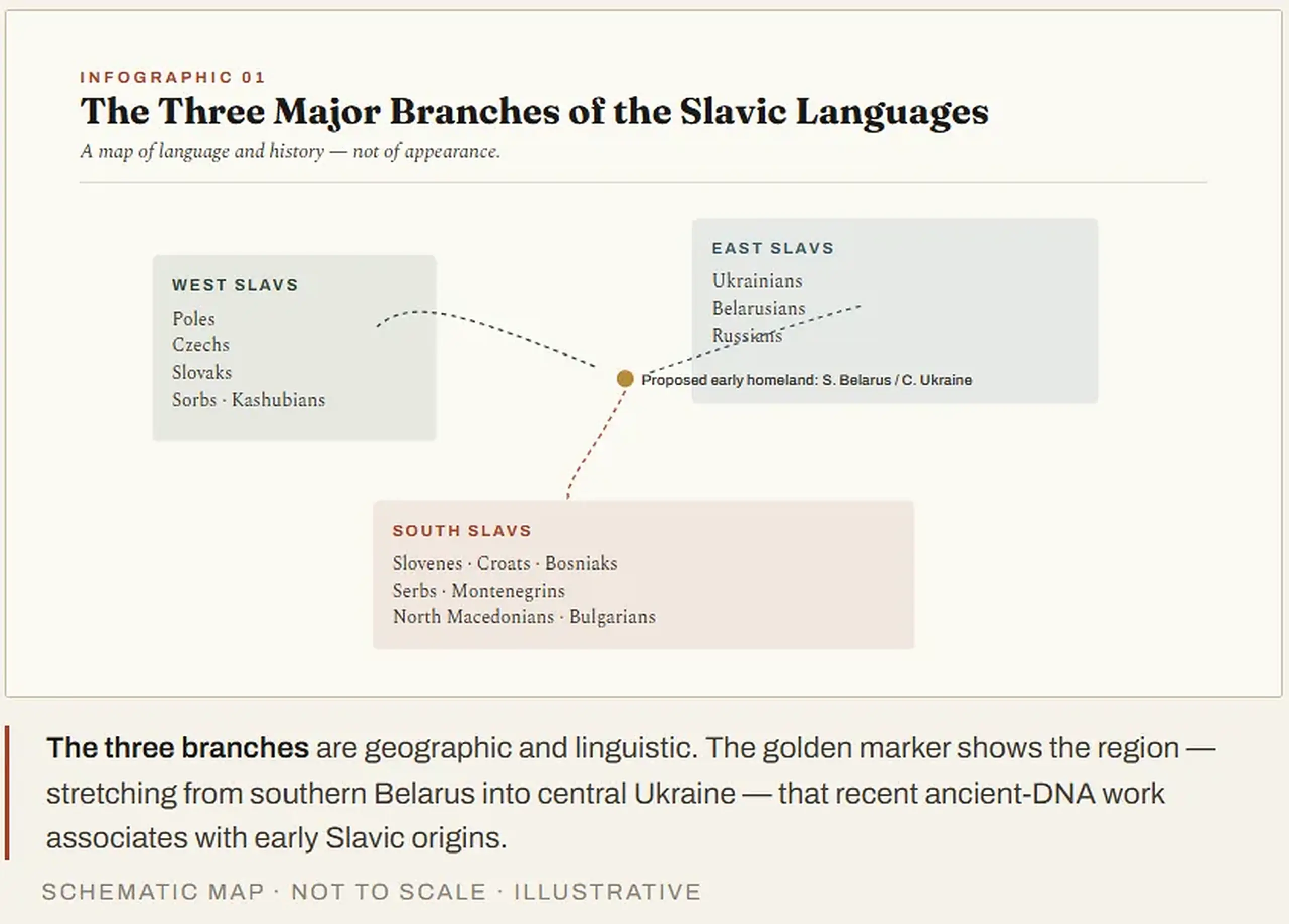
The Slavic languages descend from a common ancestor that linguists call Proto-Slavic, itself a branch of the broader Balto-Slavic and Indo-European family. Over the second half of the first millennium CE, Slavic speech spread dramatically across Central, Eastern and Southeastern Europe. Today linguists sort the living Slavic languages into three broad branches — and it is essential to understand that these branches describe language and historical relationship, not three uniform physical “types.”
East Slavs
Ukrainians, Belarusians and Russians.
West Slavs
Poles, Czechs, Slovaks, and smaller communities such as the Sorbs of eastern Germany and the Kashubians of northern Poland.
South Slavs
Slovenes, Croats, Bosniaks, Serbs, Montenegrins, North Macedonians and Bulgarians.
These groupings are real and useful. They track genuine linguistic relationships and genuine shared histories. What they do not do is carve Europe into three physical stereotypes. A person’s branch of the Slavic language family tells you something about their linguistic heritage and a great deal about their region’s history. It tells you very little about their face.
Why There Is No Single Slavic Face
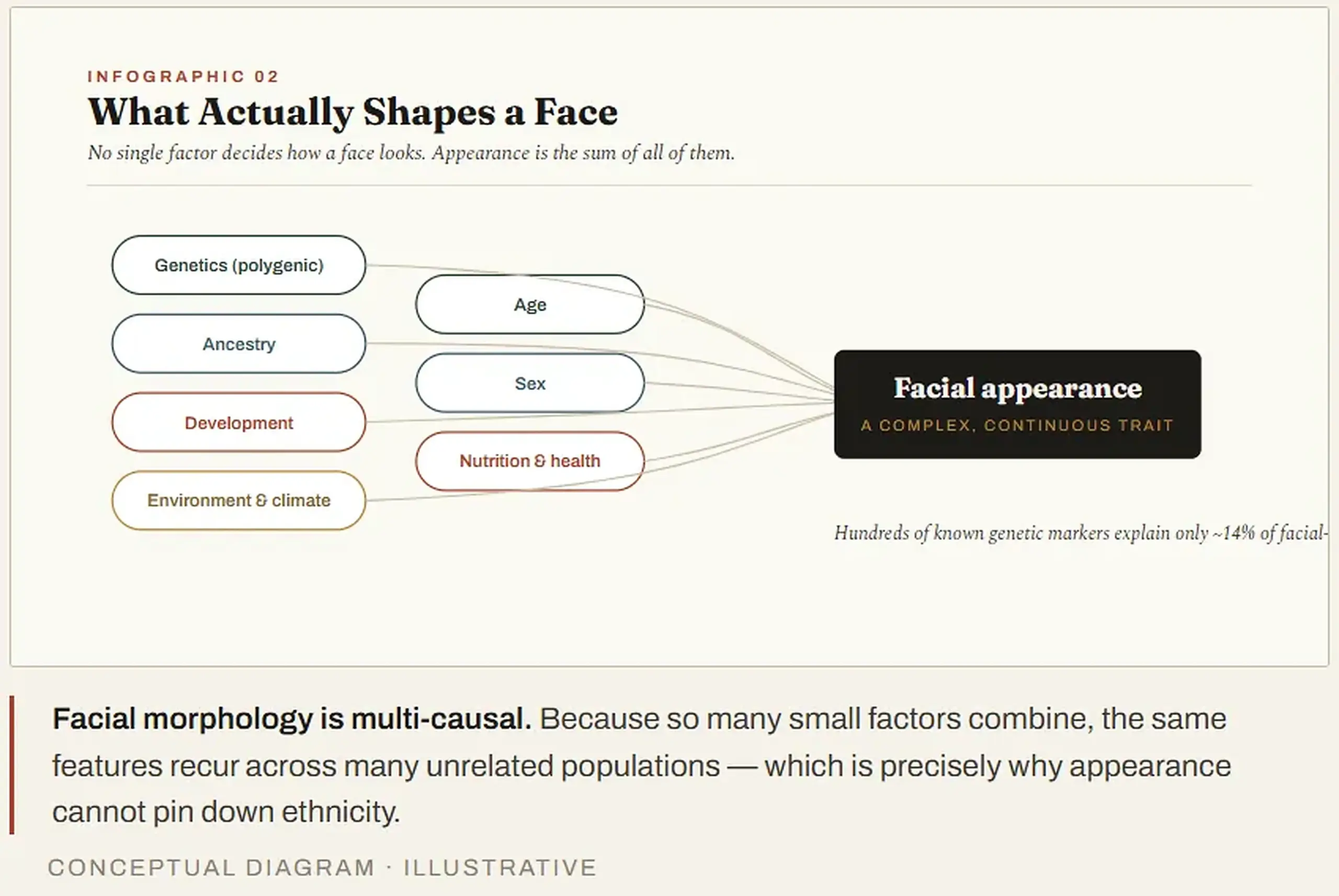
To understand why the “Slavic face” keeps slipping away, start with the biology of the face itself. Facial appearance is not one inherited trait, like blood type. It is a highly polygenic trait — the product of many genes acting together, layered over development, environment, age, sex, nutrition and health.
Over the past fifteen years, geneticists using genome-wide association studies have identified real DNA variants that nudge the shape of the nose, the width and depth of the face, the structure of the cheek and chin, the region around the eyes, and pigmentation. But the numbers tell a humbling story. The most comprehensive review of facial shape in Europeans found that hundreds of independent genetic markers — 501 SNPs across 303 loci — together explain only about 13.7% of the variation in facial shape. More than 300 loci have now been linked to facial form, and the picture keeps expanding.
Read that figure again. Even after cataloguing hundreds of contributing variants, scientists can account for only a small fraction of why one face differs from another. The genetic architecture of the face is diffuse, subtle, and — crucially — heavily shared across neighboring populations. There is no master switch. And there is certainly no “Slavic face gene.”
Knowing that genes influence the face is not the same as being able to read nationality off one. The two are separated by an ocean of biological complexity.
This is the first and most important scientific point of the article. Populations overlap enormously in every facial trait. A given nose shape, jaw or brow appears across Poland, Germany, Hungary, Serbia and Greece alike. The traits are continuous, not categorical — they blend across geography rather than stopping at borders. That is why no honest scientist will look at a photograph and pronounce the subject Slavic.
What Population Genetics Actually Tells Us About Slavs
If there is no single Slavic face, what does the genetics show? Quite a lot, and it is genuinely interesting — as long as we read it correctly.
Studies of Slavic-speaking populations consistently find substantial relatedness among many of them, combined with clear geographic structure. Eastern Slavs — Ukrainians, Belarusians and Russians — tend to be relatively genetically homogeneous with one another, and generally distinct from their non-Slavic Finno-Ugric, Baltic and Uralic neighbors, with northern Russians as a notable exception, since they shade toward their Finnic-speaking neighbors. Add Poles to the central and southern East Slavs and the genetic distances stay strikingly low, marking out a broad zone of Central-Eastern Europe with little differentiation among most Slavic speakers.
But the same research shows exactly how much geography matters. West Slavs are more internally varied than East Slavs. And the South Slavs are more differentiated still. The single most important corrective the genetics offers is this: the Slavic expansion was not the march of one genetically uniform people who replaced everyone they met. It was a layered process of migration, language shift, intermarriage, assimilation, and regional continuity. Newcomers merged with populations already living in each region, and those pre-existing populations differed from place to place. That is the deep reason Slavic-speaking peoples look different from one another today.
From the researchersDescribing the 2025 ancient-DNA findings, Johannes Krause of the Max Planck Institute for Evolutionary Anthropology said the spread of the Slavs was likely the last demographic event of continental scale to permanently and fundamentally reshape both the genetic and linguistic map of Europe.
Johannes Krause, Max Planck Institute for Evolutionary Anthropology, in coverage of Gretzinger et al., Nature (2025).
The Ancient Roots Behind Modern Slavic Diversity
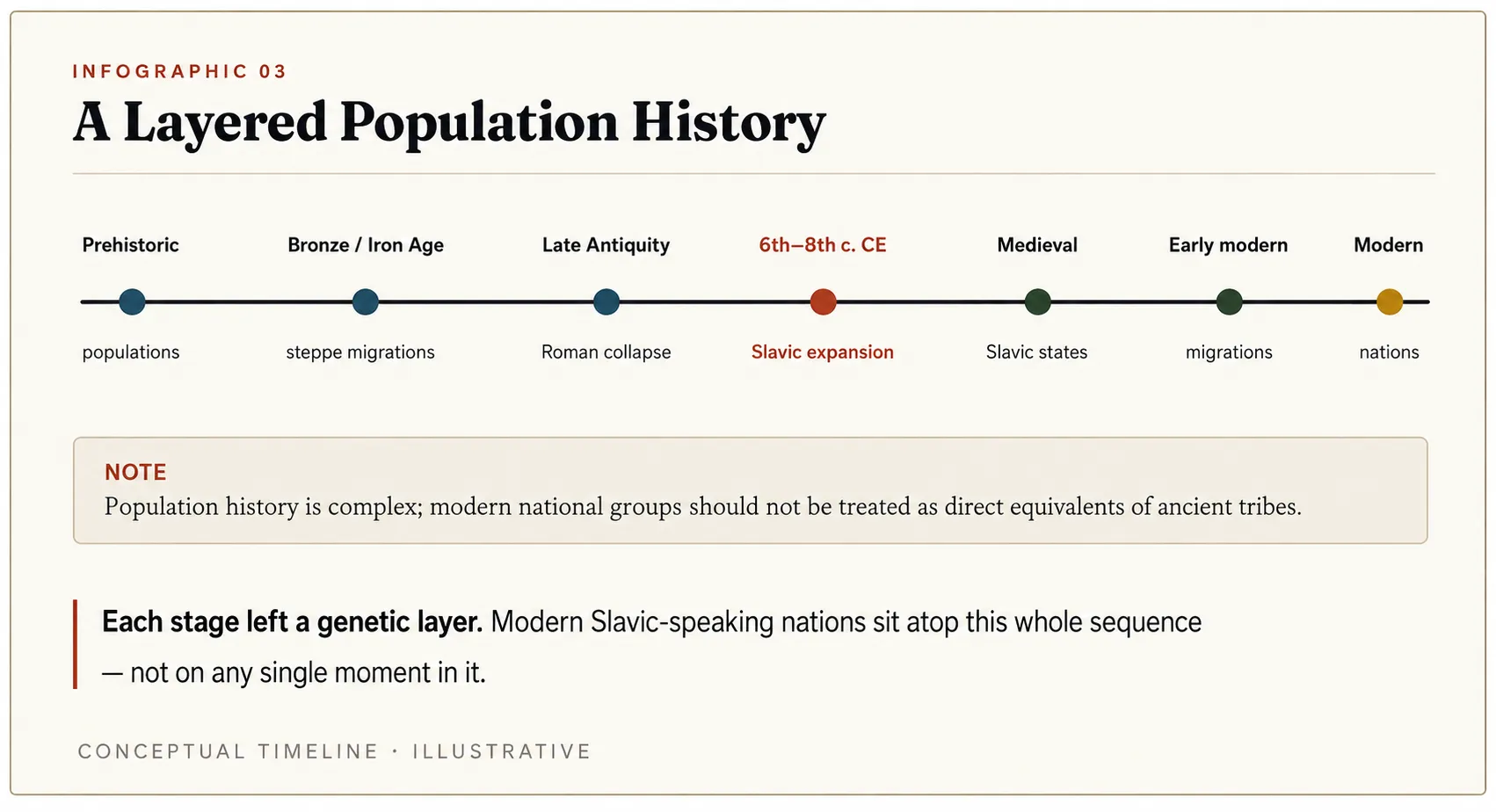
To see how that layering happened, we have to go back — but carefully. It is a mistake, and a common one, to imagine modern nations as the direct descendants of a single ancient tribe. Population history does not work that way.
Central and Eastern Europe has been continuously inhabited since the Upper Paleolithic. Over the Bronze and Iron Ages, waves of population movement — including the steppe pastoralist expansions associated with the Corded Ware horizon around five thousand years ago — laid down ancestry components that still vary smoothly across the map today. On top of that ancient substrate came the great reshuffling of Late Antiquity and the early Middle Ages, when the Roman order broke down and populations moved, and it was into this fluid landscape that Slavic languages spread from the sixth century onward.
The newest and most powerful evidence comes from ancient DNA. In September 2025, an international team led by the HistoGenes consortium published genome-wide data from 555 ancient individuals — including 359 from Slavic contexts as early as the seventh century — in the journal Nature. Their finding was striking: a large-scale movement of people out of Eastern Europe during the sixth to eighth centuries replaced more than 80% of the local gene pool in what is now eastern Germany, Poland and Croatia. The team traced the origin of this movement to a region stretching from southern Belarus into central Ukraine — an area that matches what linguists and archaeologists had long proposed.
Ancient DNA does not tell us what early Slavs looked like. It tells us how populations moved, merged and reformed — which is a far more revealing thing.
Even here, the picture is a patchwork. In the north, earlier Germanic-speaking populations had largely moved on, leaving room for Slavic settlement; in the south, the incomers merged with communities already in place. That regional unevenness — replacement in one place, blending in another — is written directly into the genetic and cultural diversity of Central and Eastern Europe today. It is worth stressing what ancient DNA does not do: it does not deliver a portrait. It reconstructs relationships and movements, not faces.
Eastern Slavs: Ukrainians, Belarusians and Russians
The East Slavic populations show real genetic affinity with one another — but “affinity” is not “identity,” and the internal variation is considerable. This branch formed across an enormous and varied landscape, from the forests of the north to the open steppe of the south, and that geography left its mark.
Over centuries, Eastern Slavic communities interacted with Baltic-speaking peoples to the northwest, Finno-Ugric populations to the north and northeast, and the many steppe populations that swept across the grasslands to the south. Northern Russian populations, for example, shade genetically toward their Finnic-speaking neighbors — a reminder that a shared language branch does not erase regional history.
Ukraine is an especially clear illustration of within-nation diversity. It is a large country that has sat for millennia at a crossroads: bordering Central Europe to the west, the Baltic zone to the north, the Black Sea and Balkan worlds to the south, and the open steppe to the east and southeast. Western, central, southern and northeastern regions each have distinct histories of settlement, movement and contact. The honest conclusion is not that there is a “western Ukrainian face” and an “eastern Ukrainian face” — those are stereotypes — but that Ukrainian appearance is itself diverse, because Ukrainian population history is itself layered.
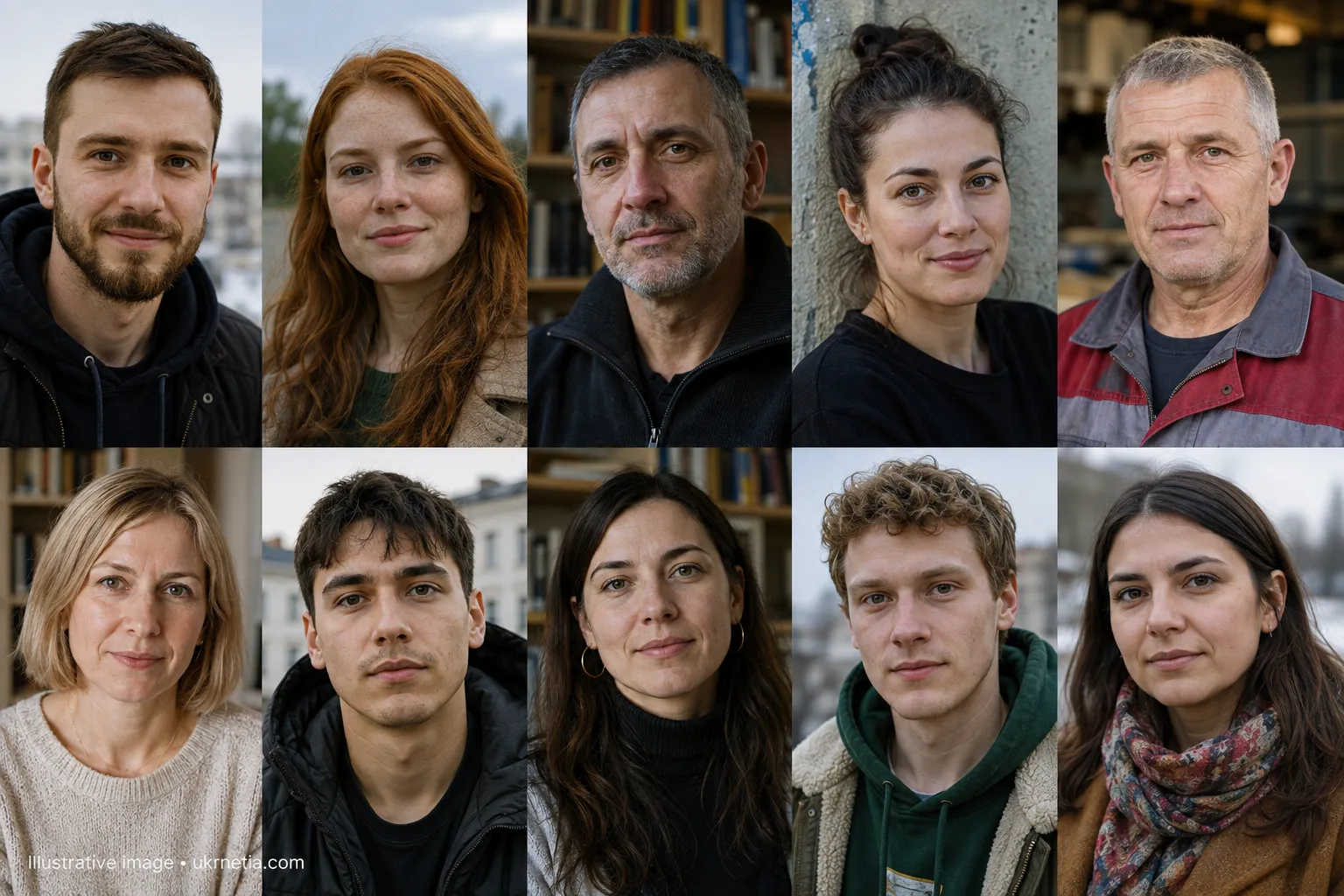
Western Slavs: Poles, Czechs and Slovaks
The Western Slavic populations sit in the heart of Central Europe, and their genetics reflect that position. This is the branch where the role of geography becomes almost visible in the data.
Studies consistently find that Poles cluster close to their Eastern Slavic neighbors — genetic distances stay low across a broad Poland–Belarus–Ukraine–western Russia zone. Czechs, however, sit noticeably shifted toward Germans and other Central and Western Europeans, and Slovaks fall somewhat in between. Researchers attribute this to the region’s history of contact between Slavic and Germanic-speaking populations, especially south of the Carpathians, along with later medieval and modern movements of people in both directions.
There is a nice detail here that captures the whole principle: the Sorbs, a West Slavic-speaking community living inside present-day Germany, remain genetically close to Poles and East Slavs rather than to their immediate German neighbors — while Czechs, further east, lean the other way. Language and genetics do not move in lockstep. Both are shaped by history, but they can pull in different directions, and where they diverge, the story gets more interesting, not less.
A Czech may be more easily mistaken for a Bavarian than for a fellow Slav from the Balkans. That is not a failure of “Slavicness.” It is simply what a thousand years of Central European geography produces.
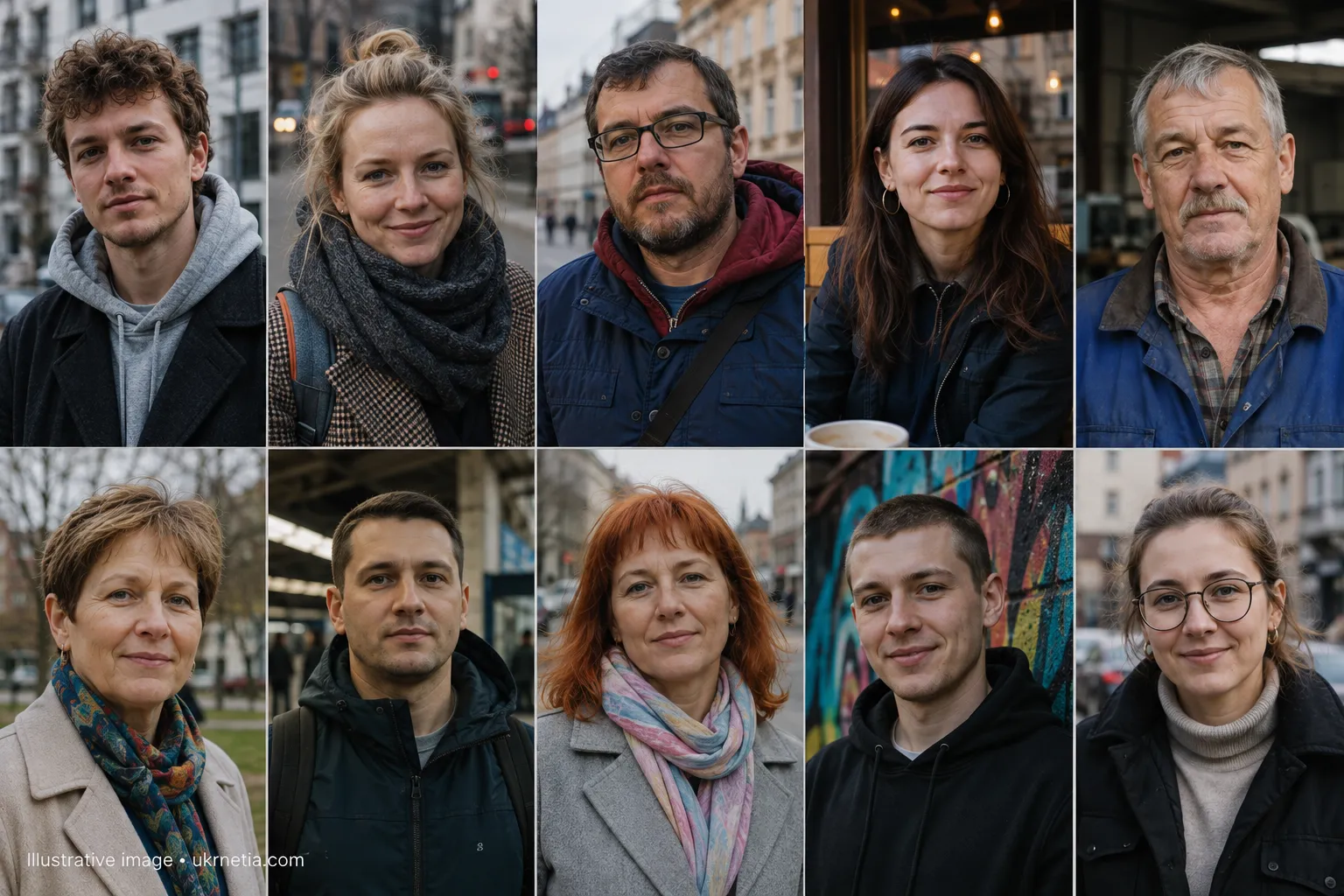
Southern Slavs: Why the Balkans Look Different
If you want to understand why “Slavs all look alike” is a myth, look south. The Balkans have one of the most complicated demographic histories in Europe, and the South Slavic populations that formed there carry that complexity in their genes.
When Slavic speakers moved into the Balkans in the sixth and seventh centuries, they did not arrive in an empty land. They met and mixed with populations descended from the region’s earlier inhabitants — the Illyrian-speaking peoples of the western Balkans, the Thracian and Dacian peoples further east, and the long Greek and Roman presence throughout — as well as later arrivals such as the Avars, and neighbors including Albanians, Vlachs and others. Crucially, this pre-Slavic substrate was itself not uniform: the western Balkans and the eastern Balkans carried different ancestral profiles before the Slavs ever arrived.
The result is that South Slavic populations show greater internal differentiation than most East and West Slavic populations. The proportion of early Slavic ancestry varies markedly across the region, and the local substrate it blended with varies too. Genetically, a Serb’s nearest neighbor may be a Romanian; a Croatian and a Slovene share much with their Western Slavic neighbors to the north; Bulgarians and Macedonians sit at the far end of a north–south gradient. This is exactly why a Slovene, a Croat, a Serb, a Macedonian and a Bulgarian may not resemble one another in any simple way — and why none of them “looks less Slavic” than a Pole. They are fully part of the Slavic linguistic family. Their diversity is the Balkans speaking through them.
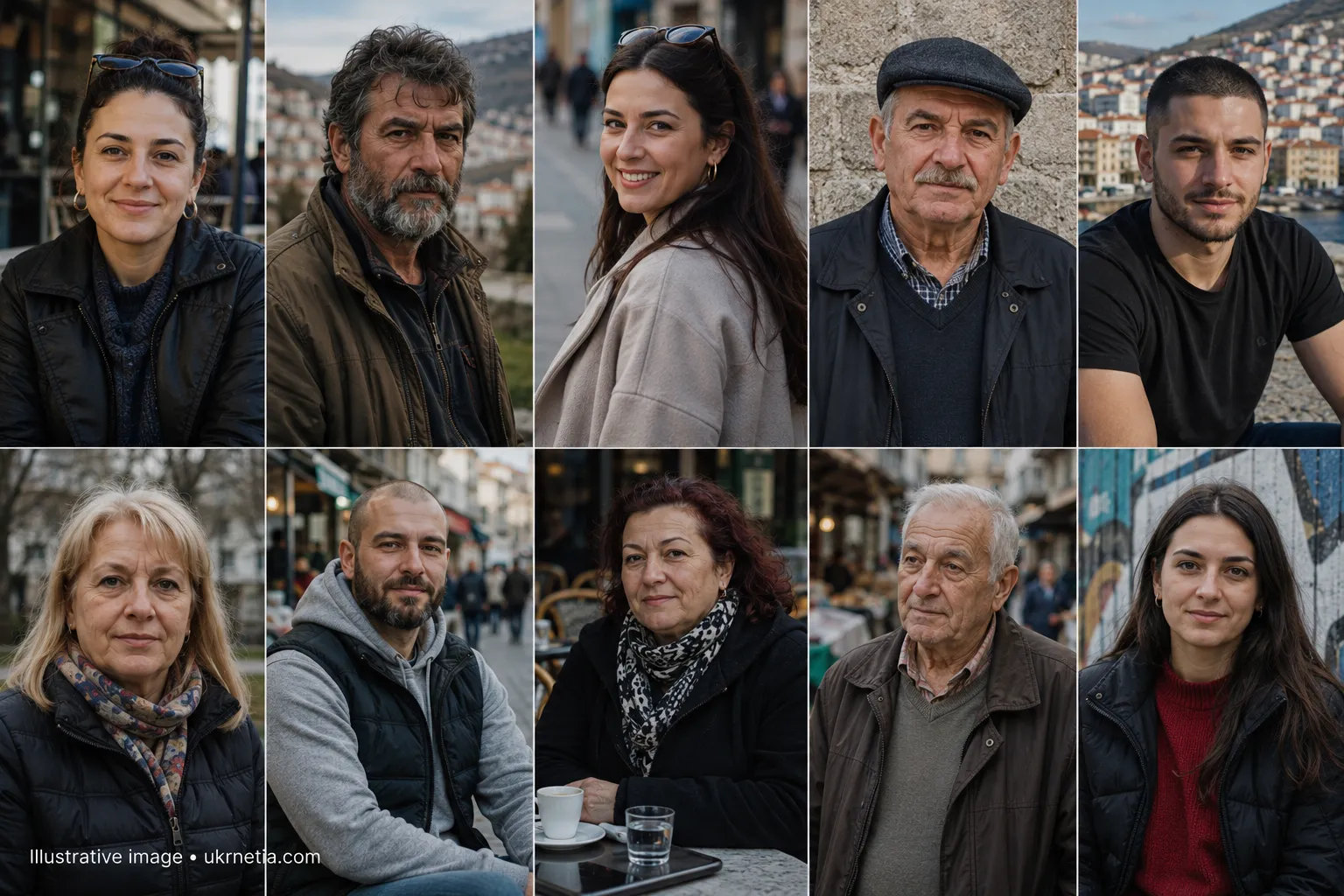
Are Slavic People Usually Fair-Skinned?
Here is a question the search engines see constantly, and it deserves a precise answer rather than a slogan. Skin pigmentation varies considerably across Slavic-speaking populations. Northern latitude does correlate, at the population level, with somewhat lighter pigmentation in Europe generally, and many Slavic-speaking populations do sit toward the lighter end of the European range on average. South Slavic populations often show different distributions from more northern ones.
But the honest formulation is not “Slavs have pale skin.” It is this: many Slavic-speaking populations have relatively light pigmentation on average, but the range is broad and overlaps extensively with neighboring European populations. Skin tone is influenced by many genes and by deep evolutionary history, it varies within every one of these populations, and it does not stop at any linguistic or national border.
What About Hair Color?
Hair color across Slavic populations spans the full European spectrum: dark blond, light brown, medium and dark brown, black, the occasional red, and — with age — gray. The stereotype of the uniformly blond Slav is an incomplete picture. Blond and light-brown hair are common in many northern and eastern populations, but dark hair is entirely ordinary across the Slavic-speaking world, and it becomes more frequent as you move south. Rather than invent percentages, the responsible thing to say is that no single hair color characterizes Slavic populations, and that variation is the rule.
What About Eye Color?
Eye color follows a broadly similar geographic logic. Blue and gray eyes are common in many Northern and Eastern European populations, including many Slavic ones; green and hazel appear throughout; brown becomes more frequent toward the south. But blue eyes are widespread across all of Northern and Eastern Europe — they are not a uniquely Slavic trait, and they certainly do not define Slavic identity. Eye color, like the rest, is governed by several genes and is a poor ethnic identifier. Plenty of Ukrainians, Poles and Russians have brown eyes; plenty of Germans, Lithuanians and Finns have blue.
Are There Typical Slavic Nose Shapes?
The “Slavic nose” is one of the most searched-for ideas on this whole subject, so let us be exact. Nasal morphology — width, bridge height, projection, tip shape, overall proportion — varies enormously within every Slavic population. There is no scientifically validated “Slavic nose.”
What science does know is intriguing but general: nose shape is shaped by many genes, by development, and by climate. Studies have found that nasal width and length correlate, across humanity, with temperature and humidity — evidence of long-term adaptation to local environments. That is a story about latitude and deep time across whole continents, not about drawing a nose that says “Polish” or “Serbian.” Any chart that claims to do the latter is selling a stereotype dressed as science.
Face Shape, Cheekbones and Jawlines
The same holds for the traits people most often invoke when they describe a “Slavic look”: high cheekbones, facial width, jaw and chin shape, forehead, the overall length of the face. Every one of these varies enormously within populations, and every one overlaps with neighboring peoples. Much of what circulates online as a description of “Slavic facial features” is really a blend of aesthetic preference, fashion and stereotype — not a finding from population science. High cheekbones, in particular, get treated as a Slavic signature; in reality, cheekbone prominence varies widely both within and between Slavic populations, and is common far beyond them.
Why Do People Think They Can “Recognize” a Slavic Face?
If the science is this clear, why is the intuition so strong? Because human face perception is powerful, fast, and systematically biased — and several ordinary forces conspire to produce the feeling of recognition.
Familiarity
People become skilled at reading faces from populations they encounter often. A person who grows up around Ukrainians develops fine-grained expectations about “typical” faces — expectations that are real to them but local, not universal.
Regional clustering
Nearby populations really do share statistical tendencies. This gives the intuition a kernel of truth, which is exactly what makes it so persuasive and so misleading.
Stereotypes and media
Film, advertising and social media supply a steady stream of images labeled by nationality, training viewers to expect a “look” that the images themselves manufactured.
Fashion and grooming
Haircuts, makeup, facial hair and clothing carry strong cultural signals. Much of what reads as ethnicity is actually style.
Photography
Lighting, lens choice and — above all — which photos get selected and shared can create a thoroughly misleading impression of a whole population.
Confirmation bias
People remember the faces that fit their expectation and quietly forget the ones that do not. The stereotype survives on a curated memory.
Put together, these forces produce a confident sense of recognition that has little to do with biology. Perceived ethnic appearance and actual ancestry are simply not the same thing.
Can You Tell If Someone Is Slavic by Looking at Them?
Usually, no. A face cannot reliably establish a person’s nationality, language, ethnicity, citizenship or ancestry.
It is worth distinguishing two very different things. Under controlled conditions, a trained forensic or anthropological analysis can sometimes estimate a broad population affinity — a statistical statement about which reference populations a set of measurements most resembles. That is not the same as glancing at a stranger and declaring them Polish, Ukrainian or Serbian. The first is a probabilistic, population-level inference hedged with uncertainty; the second is a category error. Individual faces overlap far too much between neighboring populations for casual identification to work.
Why Neighboring Non-Slavic Peoples Can Look “Slavic”
Here is the corrective that dismantles the whole idea. Populations that are not Slavic at all frequently look indistinguishable from Slavic ones — because appearance follows geography, and geography does not respect language families.
A Hungarian can resemble a Slovak. A Romanian can resemble a Bulgarian. A German from the east can resemble a Pole. Lithuanians and Latvians, Austrians, Greeks, Albanians, various Finnic-speaking populations, and Romani communities all share, to varying degrees, the continuous field of genetic and physical variation that runs across this part of Europe. Indeed, genetic analyses sometimes find a Hungarian sitting closer to both Czechs and Croatians than those two Slavic populations sit to each other.
None of this means these groups are “secretly Slavic.” It means that facial and genetic variation blends smoothly across the map, and that no linguistic or political border marks a sudden change in how people look. Overlap between neighbors is not an anomaly. It is the normal condition of human populations.
How Culture Changes the Way We Perceive Appearance
“Appearance” is never just bone and pigment. When we look at a person, we read hairstyle, clothing, makeup, facial hair, posture, expression and photographic style all at once, and we fold them into a single impression of identity. A haircut can do more to make someone “look Polish” than any bone structure.
This has a long history. National identities were built visually as much as politically — through portrait painting, folk costume, military uniform, photography, cinema and poster art. These images taught whole societies what a nation was supposed to “look like,” and they still shape our expectations. Much of what feels like an intuition about faces is really an inheritance from visual culture.
The “Slavic Beauty” Stereotype
Online, all of this crystallizes into the popular notion of “Slavic beauty”: pale skin, light eyes, high cheekbones, symmetrical features, tall stature, particular hair colors. It is important to name this for what it is — a cultural and aesthetic stereotype, amplified by social media and the beauty industry, not a biological definition of a people. The point here is not to judge anyone attractive or unattractive. It is to notice how an aesthetic ideal gets assembled, marketed and mistaken for a description of reality. The stereotype tells you about the marketplace of images. It tells you nothing reliable about the range of real human faces across Slavic-speaking Europe.
National Appearance Is Not “Slavic” Appearance
It helps to separate concepts that get carelessly merged. “Ukrainian appearance,” “Polish appearance,” “Serbian appearance” and “Slavic appearance” are not equivalent ideas. A national population may show some measurable statistical tendencies — but national populations are themselves internally heterogeneous. And “Slavic” is broader still, spanning dozens of populations across half a continent.
An analogy makes the scale clear. Asking “what do Slavic people look like?” is like asking “what do Europeans look like?” There is no single European face, and for exactly the same reasons, there is no single Slavic one.
Ukraine as a Portrait of Slavic Diversity
Because this is Ukrnetia, Ukraine makes a fitting closing case — not as a nationalist claim, but as a clear demonstration of the whole argument. Ukraine is geographically vast and historically a crossroads. Its western regions carry long connections with Central Europe; its north shades toward the Baltic and forest zones; its south opens onto the Black Sea and the Balkan and Mediterranean worlds; its east and southeast border the open steppe that carried population after population across it.
Recent ancient-DNA work even places part of the early Slavic homeland in the zone running from southern Belarus into central Ukraine — the land from which the great expansion partly radiated. Yet the modern Ukrainian population is not a preserved snapshot of that moment. It is the sum of everything that has moved across and settled in this territory since. The result is real internal diversity — best described through population history rather than through invented regional “types.” Ukraine does not have one face. It has the many faces that a crossroads produces.
What Ancient Art Can and Cannot Tell Us
People sometimes reach for old images to settle the question — medieval icons, manuscripts, sculptures, frescoes. It is worth being clear about what such sources can do. Art is not photography. Medieval and early artists stylized faces heavily, worked within religious and artistic conventions, and rarely aimed to record ethnicity or individual likeness at all. An icon tells us a great deal about belief, patronage and artistic tradition, and very little about the actual range of faces in a medieval community. These images are precious cultural evidence. They are not photographic evidence, and reading them as such produces confident errors.
Can Archaeology Reconstruct What Early Slavs Looked Like?
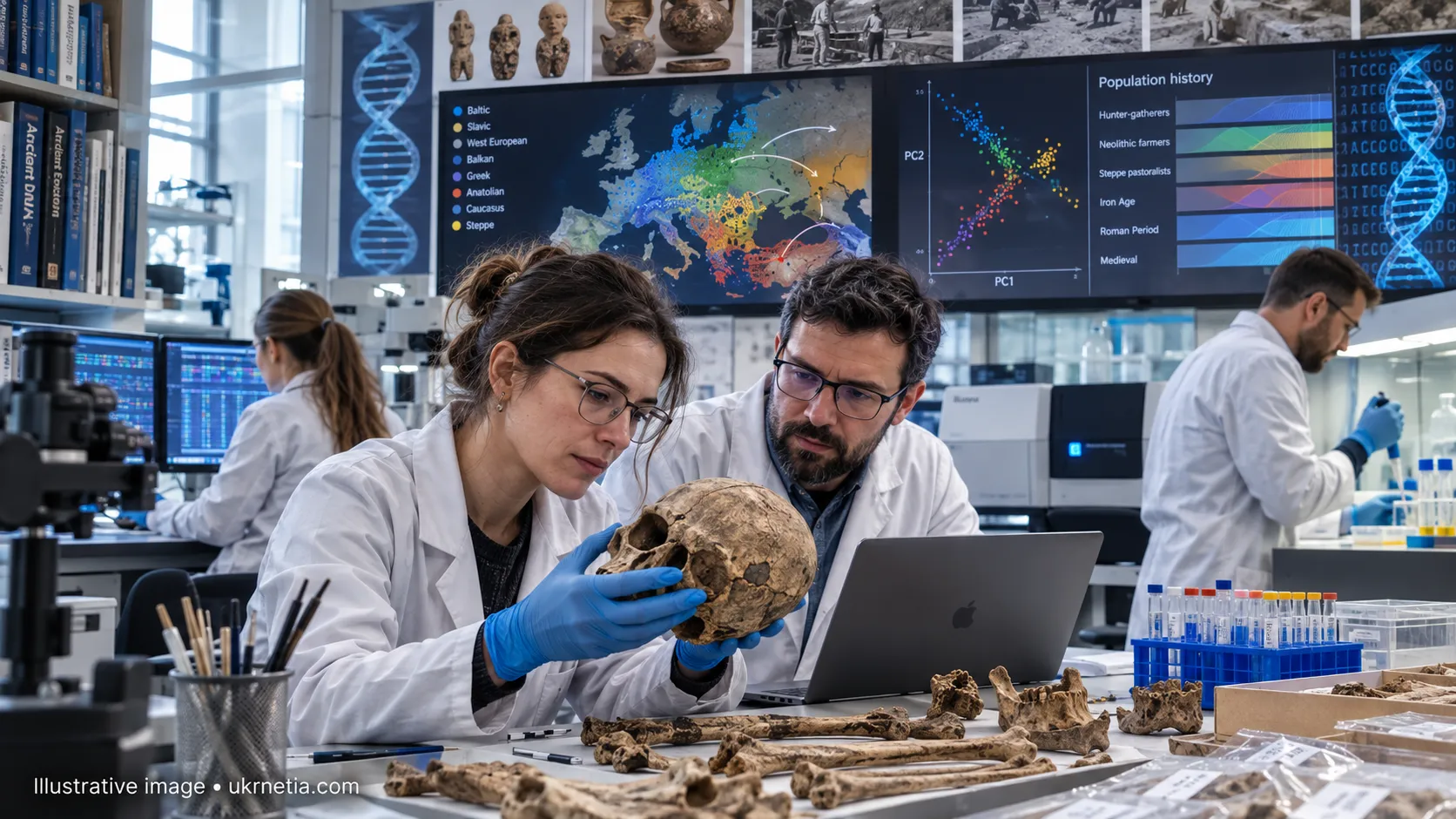
Archaeology offers more rigorous tools — skeletal remains, cranial measurement, ancient DNA, isotope analysis, and the context of burials — but each has firm limits. Skeletons reveal build, health, diet and sometimes movement across a landscape; ancient DNA reveals relationships and, increasingly, some pigmentation-related variants; isotopes trace where a person grew up. What none of them delivers is a photograph. Facial reconstructions built from skulls are genuine scientific work, but they rest on averaged soft-tissue assumptions and carry real uncertainty, especially for features like the nose, lips and ears. A reconstruction is an informed estimate, not a portrait — and it certainly is not a template for a whole people.
The New Ancient-DNA Revolution
For most of the twentieth century, the study of Slavic origins leaned heavily on modern populations, reasoning backward from present-day genetics to the past. Ancient DNA has transformed that. Instead of inferring history from living people, researchers now read it directly from historical individuals — and the results have repeatedly complicated the neat old stories.
The 2025 Nature study is the flagship example. By sequencing hundreds of early medieval genomes, it showed that Slavic expansion was, at its core, a movement of people — while also revealing that the process differed sharply from region to region, with near-total population turnover in some areas and blending in others. Early Slavic populations were not genetically uniform, language spread and genetic change did not perfectly coincide everywhere, and the map that emerged is a patchwork rather than a monolith. This is exactly the kind of nuance older, modern-DNA-only studies could not resolve. It is also a caution: powerful as it is, ancient DNA reconstructs population movements and relationships. It does not hand us a face.
Why Genetics Cannot Give Us a “Slavic Face”
Return, finally, to the central question with everything now in view. Genetic similarity between populations is statistical. There is no boundary in the genome where “Slavic DNA” begins and “non-Slavic DNA” ends. Neighboring European populations share the overwhelming majority of their genetic variants. Facial traits are polygenic and continuous. Every individual carries a personal mixture of ancestral components that blends into the people around them.
From this, three clean conclusions follow — and they are worth stating as bluntly as possible:
| What It Is Not | What It Actually Means | Why the Distinction Matters |
|---|---|---|
| Ancestry ≠ Nationality | Your genetic ancestry does not read off your passport, and your passport does not read off your genome. | Nationality is a legal and political identity; ancestry describes aspects of biological and genealogical history. |
| Ancestry ≠ Language | Language spreads through learning, contact, migration and language shift — often faster and farther than genes. | People can adopt a language without undergoing a corresponding change in their genetic ancestry. |
| Ancestry ≠ Appearance | Faces are shaped by many genes and environmental factors, and facial traits overlap extensively across neighboring populations. | A person’s appearance cannot reliably determine their ancestry, ethnicity or nationality. |
Because all three of these are true at once, “the Slavic face” cannot be defined genetically. Not because the science is unfinished, but because the concept mistakes a language family for a biological type.
Myths vs. Reality
| Myth | Reality |
|---|---|
| “All Slavs have high cheekbones.” | Cheekbone morphology varies widely within and between Slavic populations, and prominent cheekbones are common far beyond Slavic populations. |
| “Slavs are naturally blond and blue-eyed.” | Blond hair and blue eyes are frequent in some Slavic populations but far from universal. Dark hair and brown eyes are entirely ordinary among Slavic peoples. |
| “Southern Slavs look less Slavic.” | South Slavs are fully part of the Slavic linguistic family. Their diversity reflects the Balkans’ complex and layered population history. |
| “You can identify a Ukrainian by facial features.” | Appearance alone cannot reliably establish nationality. Ukrainian populations themselves display substantial regional and individual diversity. |
| “Slavic is a race.” | Slavic is primarily a linguistic and historical classification, not a biological race or discrete biological category. |
| “All Slavs descend from one uniform ancient tribe.” | Slavic-speaking populations formed through complex processes of migration, assimilation, language change and interaction with many regional populations. |
| “Dark hair means someone is not Slavic.” | Dark hair is widespread among Slavic populations and is particularly common in many Southern Slavic populations. |
| “Blue eyes are a Slavic trait.” | Blue eyes occur across Northern and Eastern Europe and are not unique to Slavic populations. |
| “Facial recognition can determine ethnicity.” | Individual facial features overlap extensively between neighboring populations, making reliable identification of ethnicity from appearance alone impossible in ordinary circumstances. |
| “Ukrainians, Poles and Serbs should look basically the same.” | They belong to different branches of the Slavic language family and have distinct demographic and population histories, resulting in considerable variation. |
So, What Do Slavic People Actually Look Like?
Here, at last, is the direct answer readers came for. Slavic people look like Europeans from a very large geographic region, connected by deep shared history and marked by enormous individual variation. There are population-level patterns. There are regional tendencies. There are real historical connections that the genetics can trace. But there is no single Slavic face.
What exists instead is a broad spectrum of appearances stretching from Central Europe through Eastern Europe and into the Balkans — blending, at every edge, into the neighboring peoples of the continent. That diversity is not an exception to Slavic identity or a dilution of it. It is a direct product of how Slavic-speaking populations actually formed.

Why This Diversity Makes the Slavic Story More Interesting
It is tempting to treat the lack of a single “Slavic face” as a disappointment — a question that failed to resolve. It is the opposite. The absence of a template is the most revealing thing the evidence has to say.
The history of Slavic-speaking peoples is a history of movement, of language spreading faster than genes, of migration and assimilation and intermarriage, of newcomers merging with the peoples already in place, of regional adaptation and centuries of political change. Modern appearance is the visible residue of all of that. A single Slavic face would imply a frozen, isolated people. The real face of Slavic Europe — many faces, blending outward in every direction — tells a truer and far richer story.
So the better question was never “what does the typical Slavic person look like?” It was this: why do millions of people across such a vast stretch of Europe share a Slavic linguistic and historical heritage while looking so different from one another? The answer is a thousand years of history — and it is written, quietly, in every one of those faces.
Frequently Asked Questions
What are Slavic facial features?
There is no scientifically defined set. Facial traits vary enormously across and within Slavic-speaking populations and overlap heavily with neighboring peoples. What circulates online as “Slavic features” is largely stereotype and aesthetic preference, not population science.
Is there a typical Slavic face?
Are Slavs genetically related?
Are all Slavs white?
Are Slavs usually blond?
What color eyes do Slavs have?
Do Russians and Ukrainians look similar?
Do Poles and Ukrainians look similar?
Why do Southern Slavs look different?
Are Slavs a race?
Can you tell if someone is Slavic by appearance?
Are Slavic facial features genetic?
What are Eastern, Western and Southern Slavic features?
Why are Slavs genetically diverse?
Did ancient Slavs look like modern Slavs?
Can DNA tell whether someone is Slavic?
Why is “Slavic appearance” so hard to define?
Sources & Further Reading
Peer-reviewed research and primary reporting underpinning this article. Population genetics is an active field; findings are provisional and continually refined.
- Gretzinger, J., Biermann, F., Mager, H. et al. (2025). Ancient DNA connects large-scale migration with the spread of Slavs. Nature 646, 384–392. doi:10.1038/s41586-025-09437-6. nature.com/articles/s41586-025-09437-6
- Schulz, I. et al. (2025). Ancient genomes provide evidence of demographic shift to Slavic-associated groups in Moravia. Genome Biology. doi:10.1186/s13059-025-03700-9
- Genetics and Slavic languages (2020). Brill Encyclopedia of Slavic Languages and Linguistics — synthesis of Slavic population-genetic structure (Poles near East Slavs; Czechs shifted toward Western Europeans; Sorbs close to Poles/East Slavs).
- Rębała, K. et al. (2013); Woźniak, M. et al. (2010). Studies of West Slavic paternal genetic structure, showing Czech/Slovak intermediacy toward Central European populations.
- Kushniarevich, A. et al. — comparative analyses of Slavic and neighboring populations; MDPI review, The Spectrum of Disease-Associated Alleles in Countries with a Predominantly Slavic Population (2024), Int. J. Mol. Sci. mdpi.com/1422-0067/25/17/9335
- Kovačević, L. et al. (2014). Standing at the Gateway to Europe — The Genetic Structure of Western Balkan Populations. PLOS ONE 9(8):e105090. journals.plos.org
- White, J.D., Indencleef, K., Naqvi, S. et al. — reviews and GWAS of human facial shape reporting ~300+ loci and ~14% of variance explained (501 SNPs / 303 loci). See also PMC10939500 on the highly polygenic nature of facial shape. ncbi.nlm.nih.gov/pmc/articles/PMC10939500
- Liu, F. / Paternoster, L. et al. (2012 onward). GWAS of normal facial morphology (PAX3 and nose shape; subsequent loci for facial width, depth and nose). Nose width/length correlate with climate (temperature, humidity).
- Max Planck Institute for Evolutionary Anthropology / HistoGenes consortium — public commentary by Johannes Krause, reported in Sci.News, Phys.org and University of Warsaw releases (Sept. 2025). sci.news/archaeology/slavs-14214.html
- Curta, F. The Making of the Slavs (2001) and Plokhy, S. The Origins of the Slavic Nations (2006) — foundational scholarship on early Slavic ethnogenesis and the historiography of Slavic identity.
Note: All named quotations in this article are drawn from published statements. Where a precise wording could not be independently verified, the underlying research is paraphrased rather than quoted.