Russia Has Destroyed 90% of Ukraine’s Modern Goods Storage Facilities, Minister Says

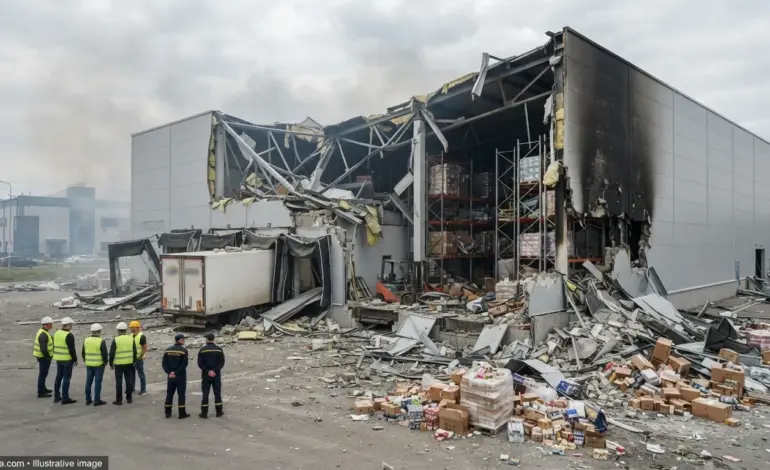

- Russian attacks have destroyed around 90% of Ukraine’s modern facilities for storing goods, according to Agriculture Minister Taras Vysotskyi.
- The minister stressed that this does not mean Ukraine is facing a threat of famine.
- However, continued attacks on warehouses and logistics infrastructure could affect the range of goods available in shops.
- Retailers are increasingly turning to deliveries directly from suppliers to stores, bypassing conventional warehouse storage.
- This approach is more complicated and expensive, while some companies have attempted to relocate their warehouses only to see attacks reach the new facilities as well.
- Recent strikes have hit distribution centers belonging to major Ukrainian retailers and logistics companies, further disrupting the country’s supply chains.
Russia’s escalating attacks on warehouses and logistics centers are putting significant pressure on Ukraine’s retail supply chain. Agriculture Minister Taras Vysotskyi says around 90% of modern goods-storage facilities have already been destroyed, although he stressed that Ukraine is not facing a threat of food shortages or famine.
Russia Has Destroyed Most of Ukraine’s Modern Storage Infrastructure
Russian attacks have destroyed approximately 90% of Ukraine’s modern facilities used to store goods, according to Agriculture Minister Taras Vysotskyi.
He made the statement during a briefing on August 28, describing the scale of damage to the country’s logistics infrastructure.
The destruction is creating a major challenge for retailers and suppliers that depend on large distribution centers to move products efficiently around the country.
There Is No Threat of Famine
Despite the scale of the destruction, Vysotskyi stressed that Ukrainians should not interpret the situation as an imminent food crisis.
He said there is no threat of famine and that the country’s food supply system continues to function.
The immediate problem is instead the growing difficulty of storing and distributing goods.
The Main Risk Is a Smaller Choice of Products
The destruction of warehouses does not necessarily mean that supermarket shelves will become completely empty.
However, attacks on logistics infrastructure can affect the range of products available in stores.
Some products may become more difficult to deliver regularly, particularly those that require specialized storage or efficient distribution networks.
Retailers Are Rebuilding Their Logistics Systems
With traditional warehouses increasingly vulnerable, Ukrainian retailers are being forced to rethink how products move from producers to shops.
One of the most realistic alternatives is supplying products directly from suppliers to stores, effectively moving goods “straight off the wheels.”
What Does “Straight Off the Wheels” Mean?
Instead of goods arriving at a distribution center, remaining there temporarily and then being sent to individual stores, products can be transported directly to their final destinations.
This reduces reliance on centralized warehouses.
But it also makes the logistics process more complicated.
Direct Delivery Is More Expensive
Warehouse-based logistics allow companies to consolidate large volumes of goods and distribute them efficiently.
Direct deliveries can require more transport movements and more coordination.
As a result, the system is more difficult and more expensive, according to Vysotskyi.
Companies Are Also Relocating Warehouses
Some businesses are trying another solution: moving their storage facilities to different locations.
The problem is that relocation does not necessarily guarantee safety.
Vysotskyi said Russian attacks are already being recorded against facilities that companies have moved to new locations.
Recent Attacks Show the Scale of the Problem
The damage is not limited to agricultural warehouses.
Russian strikes have targeted distribution centers and warehouses used by major supermarket chains, postal companies and other retailers.
Recent attacks have affected companies including Fozzy Group, Nova Poshta and other major Ukrainian businesses.
Fozzy Group Distribution Centers Were Hit
On the night of August 4–5, Russian strikes damaged or destroyed four Fozzy Group distribution centers serving the Silpo, Fora and Thrash! supermarket chains.
Six employees were killed in the attack, according to Ukrainska Pravda’s report on the developments.
The attack demonstrated how a strike against one logistics operator can affect several retail networks simultaneously.
Attacks Continued in August
The strikes did not stop after the early-August attacks.
On August 20, another Russian attack damaged a Fora warehouse in the Kyiv region where fresh produce was stored.
The facility had reportedly been operating for only about a week.
Another Warehouse Was Hit on August 27
On August 27, a warehouse belonging to the KOLO grocery chain was damaged.
A separate warehouse in Kyiv region used by Fora was also hit that day.
These incidents demonstrate how difficult it is for companies to protect new facilities simply by relocating them.
The Attacks Are Affecting More Than Food
The broader logistics campaign is not limited to food.
Russian strikes have also damaged warehouses used for books, home-improvement products and postal deliveries.
This means the consequences can extend across the wider Ukrainian consumer economy.
Nova Poshta Facilities Have Also Been Hit
Russia has recently attacked sorting centers belonging to Nova Poshta, Ukraine’s largest private courier company.
Facilities near Kyiv and in Sumy were damaged or destroyed, according to Reuters.
The damage affects not only commercial logistics but also the delivery of goods and parcels to consumers.
Online Retail Is Also Vulnerable
Large online retailers depend heavily on distribution centers.
When a warehouse is destroyed, thousands of orders can be delayed or canceled.
The damage therefore reaches consumers even if the physical shops themselves remain open.
The Problem Is Becoming a Supply-Chain Issue
The destruction of storage facilities creates a chain reaction.
A manufacturer may still have products.
A supermarket may still have customers.
But if the warehouse connecting the two is destroyed, the normal supply chain stops working.
Warehouses Are More Than Storage Buildings
Modern distribution centers perform several functions.
They receive goods, sort them, store them, prepare orders and distribute products to multiple stores.
Destroying one large facility can therefore disrupt a large geographical area.
Centralized Logistics Creates Vulnerability
Large warehouses make retail more efficient during normal conditions.
But concentration also creates vulnerabilities during wartime.
A single strike can affect supplies intended for dozens or even hundreds of stores.
Retailers Are Now Balancing Efficiency and Security
Before the war, companies generally optimized warehouses for cost and delivery speed.
Now they must also consider whether concentrating large amounts of inventory in one location creates unacceptable risk.
This is changing how Ukrainian retailers think about logistics.
Distributed Storage Could Become More Common
One potential response is to use smaller facilities in more locations rather than relying on a few large distribution centers.
This may reduce the impact of any individual strike.
However, distributed logistics are usually more expensive and require additional coordination.
The Cost Will Eventually Reach Businesses and Consumers
When companies need more transport, more storage locations and additional security measures, their operating costs increase.
Some of these costs may eventually be reflected in retail prices.
The immediate effect may instead appear as a smaller product selection or occasional delays.
Fresh Food Is Particularly Sensitive
Fresh fruit, vegetables, dairy products and meat require more complicated logistics than many dry goods.
They may require controlled temperatures and rapid delivery.
Damage to refrigerated warehouses can therefore have particularly serious consequences for these categories.
Some Kyiv Stores Have Already Experienced Interruptions
Reuters reported that recent strikes have caused temporary shortages or reduced availability of products such as fresh produce, milk and sugar in some Kyiv supermarkets.
This does not represent a nationwide food shortage.
It shows how attacks on logistics can produce local and temporary disruptions.
Ukraine Still Has Food Production Capacity
The destruction of warehouses should not be confused with the destruction of Ukraine’s entire food-production system.
Ukraine continues to produce agricultural goods and food products.
The problem is increasingly about how efficiently those products can be stored and moved.
Logistics Can Become the Weakest Link
Even when enough food exists, consumers still need access to it.
A functioning supply chain requires transport, storage, distribution centers, shops and workers.
Attacks on any major component can disrupt the final delivery.
The Minister Wants Risk to Be Shared
Vysotskyi also raised another issue: who should bear the financial risk when goods are destroyed during Russian attacks?
He supports a more balanced distribution of risk among participants in the supply chain.
The State Is Not a Party to These Commercial Contracts
The minister emphasized that the government is not directly involved in the commercial agreements between suppliers and retailers.
These are private contractual relationships between businesses.
The proposed risk-sharing mechanism would therefore need to be developed among the companies involved.
A 50/50 Split Is Not Necessarily the Answer
Vysotskyi said risk does not necessarily need to be divided equally.
Different products have different margins, profitability levels and sales conditions.
A fixed 50/50 rule would therefore not necessarily reflect the actual economic relationship between the parties.
Risk Could Depend on the Product
The minister suggested that the distribution of losses should depend on the specific product and the economic effect of the transaction.
The principle would be that responsibility should not automatically fall entirely on one participant in the supply chain.
Insurance Could Become More Important
The discussion also highlights the growing importance of mechanisms for protecting businesses against wartime losses.
Insurance and other financial instruments could help companies manage the risk of inventory being destroyed.
Ukraine has been developing mechanisms for covering war-related business risks, although access and conditions vary.
Businesses Are Learning to Operate Under Repeated Attacks
Ukrainian companies have already adapted to years of war.
They have moved production, diversified suppliers and changed transport routes.
The destruction of warehouses is forcing another stage of adaptation.
Relocation Alone Is No Longer Enough
Moving a facility farther from the front once provided some additional protection.
But the growing range of Russian long-range weapons means that distance from the battlefield does not necessarily guarantee safety.
Recent strikes on relocated facilities demonstrate the problem.
Kyiv Is Particularly Important to the Logistics Network
The capital and surrounding region are major distribution hubs for Ukraine.
Large numbers of goods move through warehouses in Kyiv region before reaching retailers elsewhere in the country.
This makes logistics infrastructure around Kyiv strategically important.
Russia Is Hitting the Commercial Infrastructure Behind Daily Life
The recent attacks have affected warehouses, postal terminals, supermarkets and other civilian commercial facilities.
The immediate consequence is not only physical damage.
It is disruption to the systems Ukrainians rely on to obtain ordinary goods.
The Goal Appears Broader Than Individual Warehouses
When multiple companies and different types of logistics facilities are hit, the cumulative effect can be significant.
The result is pressure on the entire supply chain rather than only one business.
Logistics Disruption Can Affect the Economy
Retail logistics is a major part of the wider economy.
When distribution becomes slower and more expensive, businesses have to spend more resources simply to maintain normal operations.
That can reduce profitability and increase prices.
The Impact May Be Uneven
Not every region will experience the same disruption.
Areas closer to the most heavily targeted infrastructure are likely to face greater difficulties.
Other regions may continue receiving products through alternative routes.
Consumers May Notice Changes Gradually
The destruction of warehouses does not necessarily lead to immediate empty shelves.
Businesses can draw on existing inventories and reroute deliveries.
The more significant impact may appear over time as replacement infrastructure becomes harder to maintain.
Some Products Could Become Less Available
The minister specifically warned that attacks could affect the assortment of goods in stores.
Consumers could therefore see fewer brands or fewer product options even when basic supplies remain available.
The Most Important Message Is That There Is No Food Crisis
Despite the scale of the warehouse destruction, the government does not currently see a threat of famine.
Ukraine’s food supply system continues to operate.
The challenge is maintaining the efficiency and reliability of the logistics network.
Ukraine Is Rebuilding Logistics While the War Continues
The situation creates a difficult cycle.
Companies need to rebuild or relocate warehouses.
But new facilities can also become targets.
This means businesses must invest in infrastructure while simultaneously planning for the possibility that it could be destroyed.
The Future May Be More Decentralized
The traditional model of a few enormous distribution centers may become less dominant.
Smaller, geographically distributed warehouses combined with direct deliveries could provide greater resilience.
But that model comes with higher costs.
Direct-to-Store Deliveries May Become Normal
The “straight off the wheels” model could become a more common part of Ukrainian retail logistics.
Goods could move from producers or importers directly to shops, reducing the time they spend in centralized warehouses.
It Is a Trade-Off
This approach can reduce dependence on large warehouses.
But it requires more transport capacity, more coordination and potentially more frequent deliveries.
The result is a logistics system that is more resilient but less efficient.
The War Is Redefining Retail Logistics
For Ukrainian businesses, logistics is no longer simply a question of finding the cheapest route.
Companies must also consider survivability.
The ability to keep goods moving after an attack has become a competitive and strategic necessity.
The Same Challenge Applies to Non-Food Goods
Books, electronics, household products, construction materials and other consumer goods also depend on warehouses.
The destruction of logistics infrastructure therefore affects much more than supermarkets.
The Impact on Online Shopping Could Also Grow
Online retailers often rely on large fulfillment centers.
If these facilities are damaged, delivery times can increase and product availability can fall.
Consumers may increasingly see longer delivery times for some categories.
Postal Networks Are Also Under Pressure
Damage to courier sorting centers can affect thousands of individual deliveries.
This adds another layer to the logistics problem because consumers and businesses increasingly rely on parcel delivery.
Ukraine’s Supply Chain Is Adapting
Despite the destruction, companies are finding ways to continue operating.
They are changing routes, moving inventory and using alternative storage arrangements.
The system is under severe pressure but has not stopped functioning.
The Cost of Resilience Is Rising
Every additional warehouse, transport route or backup supplier costs money.
Ukrainian companies are therefore paying a growing premium for resilience.
That cost is likely to remain part of doing business during the war.
What Consumers Should Expect
The latest warning does not mean that Ukrainians should expect empty supermarkets.
Instead, consumers could encounter:
- temporary shortages of individual products;
- fewer brands or product choices;
- delivery delays;
- higher logistics costs;
- greater regional differences in availability.
These effects may vary depending on the location and product category.
What Businesses Are Doing
Retailers and suppliers are responding by:
- relocating storage facilities;
- reducing dependence on centralized warehouses;
- changing delivery routes;
- sending goods directly to stores;
- increasing logistical flexibility.
The process is ongoing and will continue to evolve as attacks continue.
The Challenge Goes Beyond Warehouses
A warehouse can be rebuilt.
The more difficult task is rebuilding the entire network around it: transport, workers, suppliers, refrigeration, electricity, security and distribution.
That is why repeated attacks can have effects that last longer than the physical destruction itself.
Ukraine’s Retail System Is Being Forced to Become More Flexible
The country’s retail sector has already demonstrated considerable resilience.
But the destruction of most modern storage capacity is forcing companies to redesign systems that were developed over decades.
A New Logistics Model Is Emerging
The emerging model combines multiple smaller storage locations, direct deliveries and rapidly changing transport routes.
It is less efficient than the pre-war system but potentially more adaptable to repeated attacks.
The Main Question Is How Long the Adaptation Can Continue
Businesses can absorb higher logistics costs for a period of time.
The longer attacks continue, however, the more difficult it becomes to maintain the same level of product availability and variety.
Ukraine Still Has the Capacity to Supply Its Population
The government’s current assessment is clear: the destruction of warehouses does not mean Ukraine is running out of food.
The challenge is making sure available products can continue to reach consumers reliably.
Why the 90% Figure Matters
The figure illustrates how deeply the war has affected civilian economic infrastructure.
Modern logistics facilities are essential to a functioning economy, yet they are increasingly exposed to long-range attacks.
The Damage Is Changing How Ukrainians Receive Goods
The effects may ultimately be visible not only in warehouses but in everyday shopping.
Consumers may increasingly encounter different brands, altered delivery schedules and changes in product availability.
The Supply Chain Is Becoming a Wartime System
Ukraine’s retail sector is effectively operating a logistics network designed around disruption.
That means maintaining multiple routes, moving inventory quickly and avoiding excessive dependence on any one facility.
The Economy Is Adapting, But at a Cost
Ukraine’s businesses have demonstrated an ability to adapt.
But adaptation is not free.
More expensive transportation, decentralized storage and additional security all increase the cost of keeping ordinary commerce running.
What Happens Next
Retailers are expected to continue restructuring their logistics networks while seeking safer storage locations and alternative delivery models.
The government is also discussing ways to make the distribution of war-related commercial risks fairer between participants in the supply chain.
For consumers, the key message is that there is currently no threat of a nationwide food shortage, but attacks on logistics infrastructure could continue to affect what products are available and how much it costs to deliver them.