Kyiv Considers Temporary Bus Routes During Prolonged Air-Raid Alerts


- Kyiv authorities are considering temporary surface bus routes for prolonged air-raid alerts.
- The proposed changes are intended to help passengers travel between the left and right banks of the Dnipro when metro operations are restricted.
- The Department of Transport Infrastructure of the Kyiv City State Administration confirmed that an alternative surface connection is being worked on.
- Authorities are also considering increasing the number of metro trains available for transportation from the left bank to the right bank when conditions allow.
- The proposal is not yet a permanent change to Kyiv’s transport system; it is being developed specifically for situations involving long-lasting air-raid alerts.
- Kyiv has repeatedly had to modify public transport operations because of Russian attacks and security restrictions.
Kyiv authorities are working on a new approach to public transportation during prolonged air-raid alerts. The plan could include temporary bus routes connecting the two banks of the Dnipro and additional metro capacity when conditions permit, giving residents more options when normal transport operations are disrupted.
Kyiv Considers New Transport Rules During Long Alerts
Kyiv authorities are considering changes to public transportation operations for situations when an air-raid alert lasts for an extended period.
The Department of Transport Infrastructure of the Kyiv City State Administration told Suspilne that officials are working on the possibility of introducing temporary bus routes and increasing the number of metro trains serving connections from the left bank of the Dnipro to the right bank.
The goal is to reduce the transportation problems residents face when security restrictions interrupt normal services.
Why the City Needs an Alternative
Kyiv’s public transport system is particularly dependent on the metro.
The underground railway normally provides one of the fastest ways to cross large parts of the capital, including the Dnipro.
During periods when metro operations are restricted because of security conditions, passengers can suddenly face major difficulties reaching the opposite bank.
The Proposed Solution Is Based on Buses
One of the options being considered is an alternative surface transport connection.
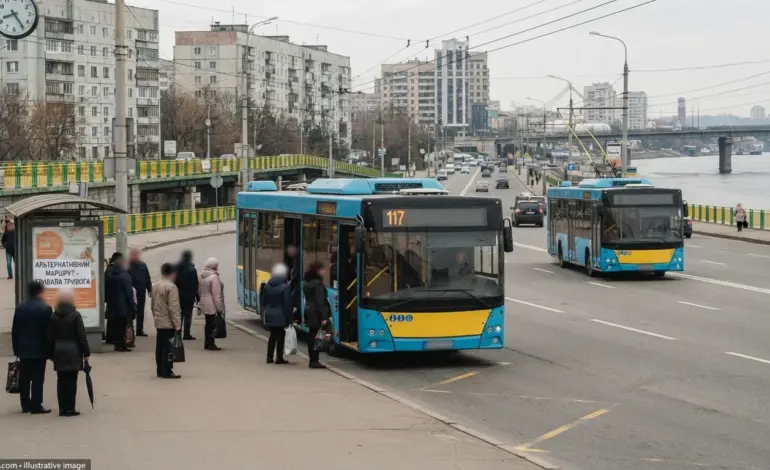
Temporary bus routes could operate during prolonged alerts to provide a way for passengers to travel between parts of the city that would normally be connected by the metro.
The Department of Transport Infrastructure confirmed that this option is currently being worked on.
The Focus Is on Long-Lasting Alerts
The proposal is not necessarily intended for every short air-raid alert.
Authorities are specifically examining what can be done during prolonged air-raid alerts, when transport disruptions can last for a significant period.
This distinction is important because a short interruption and a several-hour suspension create very different transportation problems.
The Dnipro Is the Main Challenge
Kyiv is divided by the Dnipro River into two major urban areas.
The left and right banks are connected by several bridges and transport corridors, but the metro plays a particularly important role in moving large numbers of passengers.
When normal metro operations are disrupted, alternative routes can quickly become overloaded.
Temporary Buses Could Connect the Two Banks
The proposed bus system would provide an additional option for passengers who need to cross the Dnipro during an extended disruption.
The exact routes have not yet been announced.
Officials are still working on the details of the alternative surface connection.
More Metro Trains Are Also Being Considered
The plan is not limited to buses.
The Department of Transport Infrastructure is also considering increasing the number of metro trains operating on the relevant part of the network when circumstances permit.
This could help transport more passengers once metro operations can safely resume.
Safety Remains the Main Constraint
Any change to transport operations during an air-raid alert must take security conditions into account.
The city cannot simply maintain normal transport operations regardless of the threat.
The proposed system is therefore intended to provide alternatives while respecting wartime safety requirements.
Kyiv Has Already Used Temporary Transport Routes
Temporary bus routes are not a completely new idea for the capital.
Kyiv has previously introduced replacement buses when individual metro lines or tram routes were disrupted.
For example, temporary routes were introduced after a Russian attack damaged 42 PESA tram carriages in July.
Public Transport Has Repeatedly Been Adapted
The capital’s transport system has had to respond to both security restrictions and physical damage.
After Russian attacks, individual tram, trolleybus and bus routes have sometimes been modified while repairs are carried out.
The new proposal would apply that same principle to prolonged air-raid interruptions.
The Problem Is Growing More Important
Kyiv has experienced increasingly long and frequent periods of air-raid activity.
According to a recent Kyiv City Administration weekly summary, the capital experienced 14 air-raid alerts during one recent week, with their combined duration exceeding nine hours.
Longer interruptions make transportation planning increasingly important.
A Short Alert Is Easier to Manage
When an alert lasts only a short time, passengers can generally wait for transport operations to resume.
A much longer interruption is different.
People may need to reach work, hospitals, homes, railway stations or other parts of the city while normal services remain restricted.
Long Delays Can Create Crowds
When a large number of passengers wait for transport at the same time, stations and stops can become crowded.
This creates additional challenges for both passengers and transport operators.
Alternative routes could help distribute passenger flows.
Surface Transport Could Reduce Pressure
Temporary buses would not replace the metro’s capacity.
However, they could provide an additional option and reduce pressure on major transport hubs.
Even a limited alternative connection could be useful during a long disruption.
The Exact Number of Buses Has Not Been Announced
The authorities have not yet published details of how many buses could be involved.
The number would likely depend on the expected passenger demand and the duration of the alert.
At this stage, the proposal remains under development.
No Final Routes Have Been Announced
Passengers should not yet expect a specific new bus number or timetable.
The Department of Transport Infrastructure has confirmed only that the possibility of organizing alternative surface connections is being considered.
The final route structure will depend on further planning.
The Plan Is Still Being Developed
This is important because the proposal should not be interpreted as an already approved permanent change.
Officials are working on the possibility of introducing the temporary routes.
Further announcements will be needed before passengers can use them.
Kyiv Needs Transport That Can Adapt Quickly
The proposal reflects a broader challenge for cities operating under wartime conditions.
Transport systems have to be flexible enough to respond to security restrictions while still providing essential mobility.
Kyiv’s authorities are therefore looking for solutions that can be activated when necessary rather than permanently changing the entire network.
The Metro Remains Central to the System
Even with additional buses, the Kyiv metro remains the backbone of the city’s public transportation system.
Its high passenger capacity makes it difficult to replace with buses.
That is why the authorities are considering both surface alternatives and increasing metro capacity where possible.
The Two-Bank Connection Is Particularly Important
Crossing the Dnipro is one of the most difficult transportation problems during major disruptions.
Passengers cannot simply choose another nearby metro line.
They may have to travel significantly farther or rely on already crowded bridges and surface routes.
More Options Could Help Essential Workers
Reliable transportation is particularly important for people working in hospitals, emergency services, utilities, retail and other essential sectors.
During long alerts, these workers may still need to reach their workplaces.
Alternative routes could make that easier.
The Proposal Could Also Help Families
Parents may need to travel across the city to collect children or reach relatives.
During a prolonged disruption, having an additional transport option could make these journeys less difficult.
Kyiv’s Transport System Has Become Part of Its Resilience
The ability to keep the city moving despite attacks and security restrictions has become an important aspect of Kyiv’s resilience.
Transport workers continue operating buses, trams, trolleybuses and metro services under difficult conditions.
Previous Attacks Have Shown the Vulnerability of Transport
Russian attacks have damaged transport infrastructure and rolling stock.
In July, 42 PESA tram carriages were damaged in one attack, forcing the temporary introduction of replacement bus routes.
Such incidents demonstrate why alternative transport capacity is valuable.
The New Plan Is About Preparedness
Rather than waiting for each long alert to create a transportation crisis, Kyiv is considering a system that could be activated when a disruption reaches a certain duration.
This would make the response more predictable.
It Could Become a Standard Emergency Procedure
If the proposed system proves effective, temporary routes could eventually become part of Kyiv’s established emergency transport procedures.
However, authorities have not announced such a permanent policy yet.
Passengers Should Still Follow Official Updates
Until the new system is formally introduced, passengers should rely on official Kyiv transport announcements for current route information.
Existing transport routes can change quickly depending on the security situation.
Current Transport Changes Are Published Separately
Kyiv authorities regularly publish information about temporary changes to bus, trolleybus and tram routes.
The city also provides operational updates about transport following Russian attacks.
What Could Change During a Long Alert
If the proposal is implemented, passengers could potentially see:
- temporary bus routes between the two banks of the Dnipro;
- additional metro trains where operation is permitted;
- alternative connections designed specifically for extended disruptions;
- adjusted passenger flows around major transport hubs.
The exact configuration has not yet been finalized.
What Will Not Change
The basic principle remains that passenger safety takes priority during an air-raid alert.
Transport cannot operate normally if doing so would expose passengers or employees to unacceptable danger.
The City Is Looking for a Balance
The challenge is finding the right balance between safety and mobility.
Kyiv needs to protect passengers while also ensuring that the city can continue functioning during long periods of disruption.
A Practical Wartime Transport Solution
The proposed temporary routes are not designed to solve every transportation problem.
Their purpose is narrower: provide an additional option when a prolonged alert makes normal transport arrangements impractical.
The Plan Could Be Especially Useful for the Left Bank
The left bank contains large residential areas and major transport hubs.
When connections across the Dnipro are disrupted, residents can become particularly dependent on bridges and surface transport.
Additional buses could provide another way to distribute passenger flows.
The Right Bank Would Benefit Too
The problem is not limited to residents of the left bank.
People who live on the right bank but work or study on the left also depend on reliable cross-river connections.
A temporary system would therefore serve passengers traveling in both directions.
Why the Proposal Matters Now
The discussion comes after another summer of heavy Russian attacks against Kyiv and other Ukrainian cities.
Transport authorities are having to plan not only for ordinary traffic but also for repeated emergency disruptions.
The System May Need to Be Flexible
Different alerts can last for different lengths of time.
A system designed for a 30-minute interruption may not be suitable for a five-hour disruption.
The proposed approach appears to recognize this by focusing specifically on prolonged alerts.
The City Has Not Announced a Start Date
There is currently no announced date for when the proposed temporary routes will begin operating.
The authorities are still working on the concept.
Passengers should therefore not expect the new routes to appear immediately.
What Kyiv Residents Should Know
For now, the important information is that city transport officials are developing an alternative transport plan for prolonged air-raid alerts.
The proposal includes temporary buses and potentially increased metro capacity.
More specific information should follow if the plan is approved.
The Bigger Transportation Challenge
Kyiv’s experience shows that wartime transport planning is increasingly about resilience.
The city needs systems that can continue operating even when normal routes are interrupted by security threats.
Temporary buses are one relatively simple way of creating that flexibility.
A More Flexible Transport Network
If implemented successfully, the proposal could give Kyiv a transport network that is better prepared for extended emergencies.
It would not eliminate disruptions, but it could reduce their impact on residents.
What Happens Next
The Department of Transport Infrastructure will continue developing the proposed alternative surface connections.
The exact routes, number of vehicles and operating conditions will need to be determined before the system can be introduced.
For now, the proposal remains under consideration.
Why Kyiv Is Looking Beyond the Metro
The discussion is ultimately about one simple problem: how to keep a city of millions moving when its normal transport system has to pause for safety reasons.
Temporary buses and additional metro capacity could provide part of the answer, particularly during the longest air-raid alerts.
If the proposal moves forward, Kyiv residents could eventually have a more predictable way to travel across the city even during prolonged security disruptions.