The Scythian Golden Pectoral: The Ancient Masterpiece That Revealed the Rich World of Ukraine’s Nomadic Kings

Hidden beneath an ancient burial mound in southern Ukraine for more than two thousand years, a magnificent golden pectoral transformed historians’ understanding of one of antiquity’s most mysterious peoples. Richly decorated with scenes of daily life, mythology, and the natural world, this extraordinary artifact offers a rare glimpse into the beliefs, artistry, and international connections of the Scythians—nomadic rulers who once dominated the Eurasian steppe.
On a hot summer day in 1971, archaeologists carefully removed layers of earth from a massive Scythian burial mound near the city of Pokrov in southern Ukraine. For weeks, the excavation had revealed impressive discoveries, but nothing prepared the team for what lay hidden inside one of the untouched burial chambers.
Wrapped in centuries of silence was an object unlike anything they had ever seen.
A gleaming crescent of almost pure gold.
Nearly thirty centimeters across.
Intricately decorated with dozens of human figures, horses, birds, plants, and mythical creatures so delicately crafted that even modern jewelers marvel at the precision of its workmanship.
It would become known as the Scythian Golden Pectoral—one of the greatest archaeological discoveries ever made in Ukraine and one of the finest masterpieces of ancient goldsmithing anywhere in the world.
Yet the pectoral’s true value extends far beyond its remarkable beauty.
Unlike many ancient treasures created simply to display wealth, every figure on the pectoral appears to tell a story. Scholars continue to study its intricate scenes, searching for clues about Scythian religion, social hierarchy, craftsmanship, and the complex relationships between the nomadic peoples of the Eurasian steppe and the flourishing Greek colonies along the northern coast of the Black Sea.
The discovery also challenged a long-standing stereotype.
For centuries, classical writers often portrayed the Scythians primarily as fierce mounted warriors—masters of horseback combat who roamed the vast grasslands stretching from the Danube to Central Asia. The golden pectoral revealed another side of their civilization: one capable of appreciating extraordinary artistic sophistication, maintaining long-distance diplomatic and commercial networks, and commissioning works that rivaled the finest luxury objects of the ancient Mediterranean.
More than two thousand years after it was placed inside a royal burial mound, the pectoral continues to raise new questions.
Who wore it?
Who crafted it?
Why was such an extraordinary object buried instead of passed to the next generation?
And what can a single piece of gold tell us about a civilization that left few written records of its own?
To answer those questions, we must return to the vast grasslands of the ancient Eurasian steppe, where one of history’s most fascinating nomadic cultures built an empire without cities—and left behind one of archaeology’s greatest masterpieces.
The World of the Scythians
Long before medieval kingdoms emerged in Eastern Europe, the broad grasslands stretching across what is now southern Ukraine formed part of one of the world’s great natural highways.
Known today as the Pontic–Caspian Steppe, this immense landscape connected Europe with Central Asia across thousands of kilometers of open plains. Rivers flowed south toward the Black Sea, while endless grasslands provided ideal pasture for horses, sheep, and cattle.
For highly mobile societies, the steppe offered freedom.
For traders, it became a corridor linking distant civilizations.
And for powerful nomadic confederations, it was the foundation of remarkable military strength.
Among the peoples who mastered this environment were the Scythians, Iranian-speaking nomadic groups who dominated much of the Eurasian steppe between approximately the seventh and third centuries BCE.
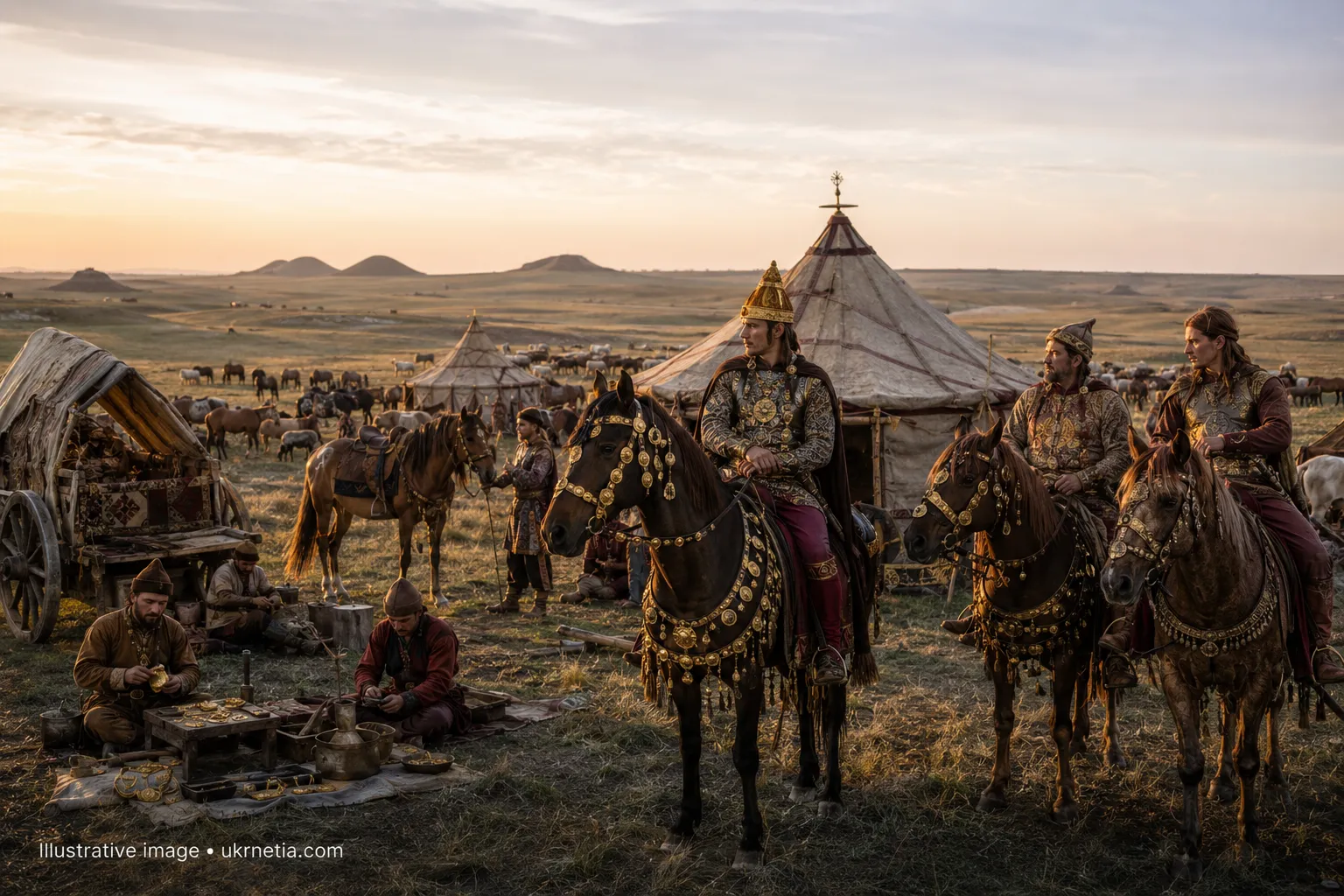
Rather than constructing monumental cities, the Scythians built their power through mobility. Their wealth traveled with them—in vast herds, skilled horsemen, elaborate wagons, and portable luxury goods that reflected both status and identity.
Ancient Greek historian Herodotus, writing in the fifth century BCE, described the Scythians as formidable warriors who could move rapidly across enormous distances. Although some of his accounts blend observation with stories gathered from others, archaeology has confirmed many aspects of Scythian life, including their exceptional horsemanship, sophisticated weaponry, and widespread burial traditions. At the same time, modern research also shows that their society was more diverse and complex than classical authors sometimes suggested.
Far from living in isolation, the Scythians maintained close relationships with the thriving Greek colonies established along the northern Black Sea coast. Cities such as Olbia, Chersonesus, and Panticapaeum exchanged grain, livestock, hides, and precious materials for wine, ceramics, luxury goods, and artistic influences.
This interaction helped shape one of antiquity’s most distinctive artistic traditions.
Scythian craftsmen developed their own celebrated animal style, depicting stags, panthers, griffins, birds of prey, and fantastic creatures in dynamic compositions that emphasized movement and strength. At the same time, elite patrons commissioned masterpieces from highly skilled goldsmiths—many of whom may have been Greek artisans working specifically for Scythian rulers or local workshops blending Greek techniques with Scythian symbolism.
The golden pectoral stands at the very center of this cultural exchange.
It is not simply a Scythian object.
Nor is it purely Greek.
Instead, it represents a remarkable meeting of civilizations, combining technical mastery associated with the Greek world and symbolic imagery that reflects Scythian beliefs, social structures, and relationships with the natural world.
Understanding this crossroads of cultures is essential.
Without it, the pectoral appears to be little more than an extraordinary piece of jewelry.
With it, the artifact becomes something far more significant: a visual document from a civilization that spoke primarily through art rather than written history.
📜 Historical Fact
Unlike Egypt, Rome, or Greece, the Scythians left almost no written historical records of their own. Much of what historians know today comes from archaeology, ancient Greek authors, and thousands of burial mounds—known as kurgans—that still dot the landscapes of Ukraine and the wider Eurasian steppe.
💡 Why It Matters Today
The Scythian Golden Pectoral reminds us that history is often preserved not only in books but also in objects. For cultures with limited written records, archaeology becomes the primary language through which their achievements, beliefs, and daily lives can still be understood.
The Discovery That Changed Scythian Archaeology
For archaeologists, every burial mound begins with uncertainty.
Most excavations uncover fragments of pottery, scattered bones, corroded weapons, or traces of structures long since collapsed. Even royal Scythian kurgans—the monumental burial mounds built for elite members of society—had often been looted centuries before modern archaeologists reached them.
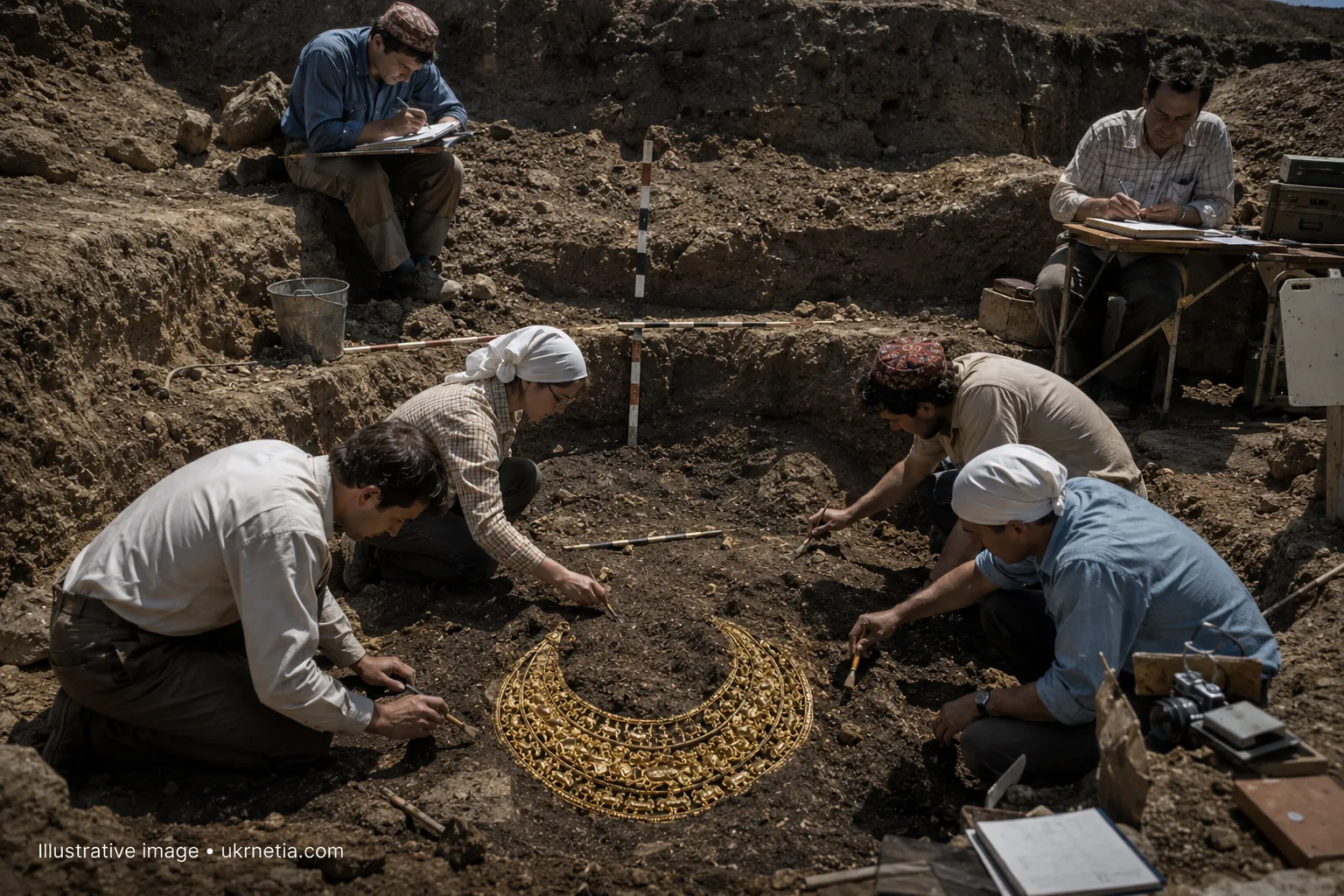
In the summer of 1971, however, an expedition led by the Ukrainian archaeologist Borys Mozolevskyi set out to investigate one of the largest Scythian burial mounds in southern Ukraine: Tovsta Mohyla (“Thick Grave”), near today’s city of Pokrov in the Dnipropetrovsk region.
At first, the excavation offered little reason for optimism.
Like many other Scythian tombs, parts of the mound had already been disturbed in antiquity. Days of careful digging produced important archaeological material, but nothing that suggested an extraordinary discovery awaited below.
Then the excavation reached a previously untouched burial chamber.
Working slowly to avoid damaging fragile artifacts, the team removed layer after layer of compacted soil. The chamber gradually revealed weapons, ceremonial objects, and precious ornaments belonging to a member of the Scythian elite.
Among them lay a remarkable object unlike anything previously found in the region.
A massive golden pectoral.
Even before conservation began, its extraordinary quality was immediately apparent. Unlike simpler ornaments recovered from many ancient burials, this was an object of astonishing complexity. Every centimeter of its curved surface was covered with miniature figures, animals, plants, and decorative motifs crafted with exceptional precision.
The discovery quickly attracted international attention.
Archaeologists realized they were looking not merely at a valuable piece of jewelry, but at one of the greatest masterpieces of ancient metalworking ever recovered from the Eurasian steppe.
📜 Historical Fact
Borys Mozolevskyi (1936–1993) was not only an archaeologist but also a poet. His persistence during the excavation of Tovsta Mohyla proved decisive. Despite difficult working conditions and limited expectations, his team uncovered what is now regarded as one of Ukraine’s most important archaeological discoveries of the twentieth century.
💡 Why It Matters Today
Many archaeological breakthroughs occur because researchers continue investigating sites that others consider exhausted or unpromising. The discovery of the Scythian Golden Pectoral is a reminder that patience, careful methodology, and scientific curiosity can fundamentally reshape our understanding of the past.
A Masterpiece in Gold
At first glance, the pectoral dazzles with its beauty.
A closer look reveals something even more remarkable: it tells stories.
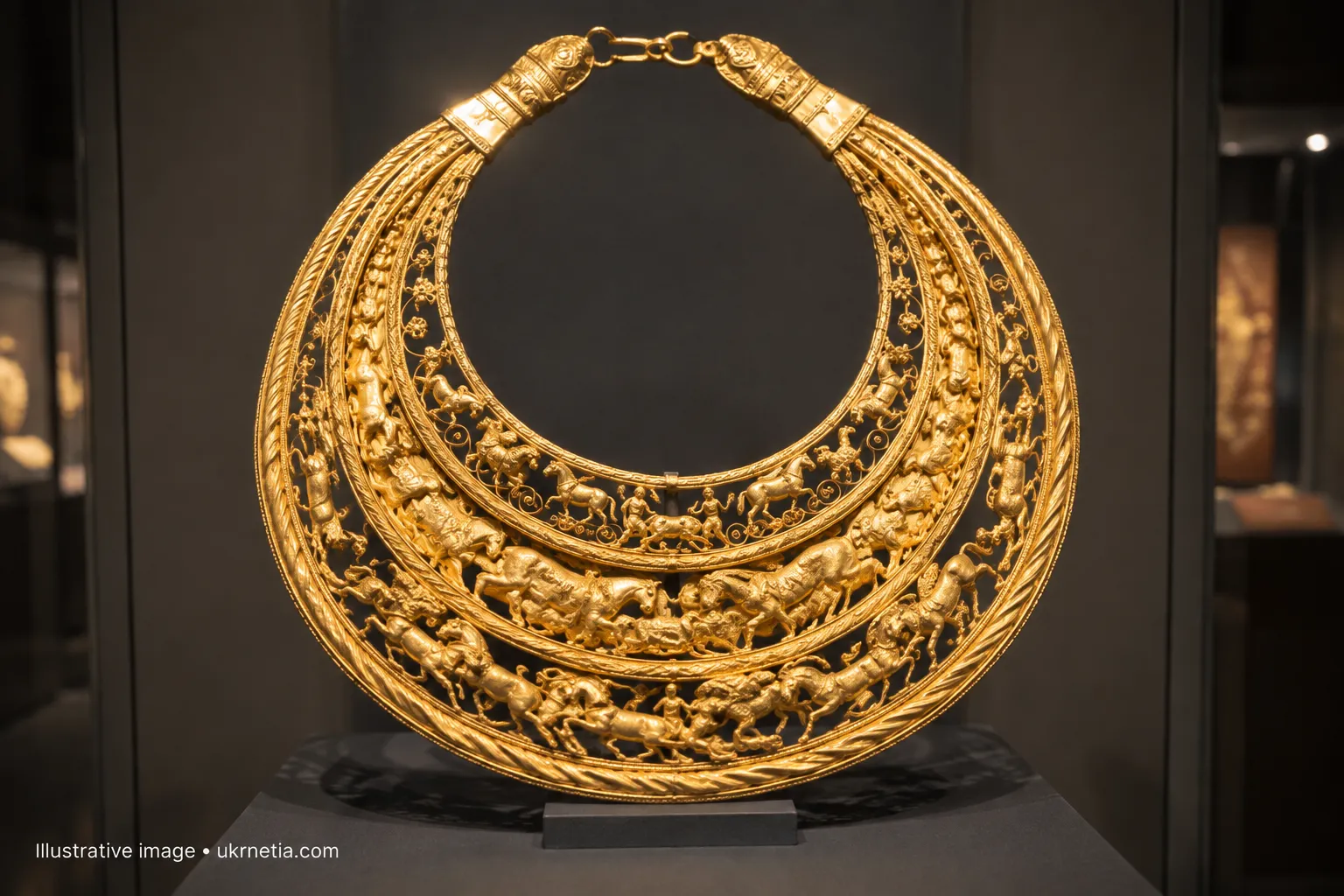
The artifact measures approximately 30.6 centimeters (12 inches) in diameter, weighs just over 1.15 kilograms (about 2.5 pounds), and was crafted from high-purity gold. Rather than being made from a single sheet, it consists of hundreds of individually fashioned components joined together with extraordinary technical skill.
Scholars generally date the pectoral to the 4th century BCE, during the height of Scythian political and cultural influence on the Pontic Steppe.
Its design is arranged in three distinct horizontal registers, each presenting a different world.
The upper register depicts scenes of human life. Two central figures—often interpreted as Scythian nobles or attendants—appear to hold a ceremonial cloak or sheepskin. Around them are carefully rendered horses, cattle, sheep, birds, and scenes of everyday pastoral life. Rather than emphasizing warfare, these images celebrate prosperity, fertility, and the rhythms of life on the steppe.
The middle register forms a richly woven band of twisting plants, flowers, leaves, and vines. This decorative layer visually separates the earthly and symbolic worlds while demonstrating the remarkable technical abilities of the goldsmith.
The lower register bursts with energy.
Predators attack prey.
Griffins seize horses.
Lions confront wild animals.
The dramatic movement reflects one of the defining characteristics of Scythian art—the famous Animal Style, in which creatures are shown in moments of tension, strength, and transformation.
Taken together, the three registers have inspired numerous interpretations.
Some scholars see them as representing different levels of the universe: the human world, the natural world, and the realm of powerful spiritual forces.
Others interpret them as symbolic reflections of life, death, and renewal.
Because the Scythians left no written explanation of the pectoral’s imagery, none of these interpretations can be accepted with complete certainty. Instead, archaeologists compare the scenes with other Scythian artifacts, ancient religious traditions, and parallels from neighboring cultures.
That uncertainty is part of the artifact’s enduring fascination.
Rather than offering simple answers, the pectoral invites each new generation of researchers to ask better questions.
📜 Historical Fact
Microscopic study of the pectoral demonstrates an exceptional command of ancient goldworking techniques, including casting, soldering, chasing, engraving, and the assembly of numerous individually crafted decorative elements into a single harmonious composition.
💡 Why It Matters Today
The pectoral demonstrates that the societies of the Eurasian steppe valued not only military power but also artistic excellence. It challenges outdated stereotypes that portray nomadic cultures as lacking sophisticated visual traditions.
📌 Did You Know?
Although often described simply as a “neck ornament,” the golden pectoral was almost certainly a ceremonial object reserved for a member of the Scythian elite. Its weight, complexity, and symbolic decoration suggest it served as a prestigious insignia rather than an item intended for everyday wear.
Reading the Pectoral: A Story Told in Gold
Most ancient treasures impress with their craftsmanship.
The Scythian Golden Pectoral does something more remarkable—it communicates.
Unlike a crown, sword, or ceremonial cup, the pectoral unfolds almost like a visual manuscript. Every figure appears carefully positioned, every animal intentionally chosen, every decorative element part of a larger composition.
Rather than presenting isolated ornaments, the artist created a narrative that invites viewers to move their eyes across the object, discovering one scene after another.
More than twenty-three centuries later, that silent story is still being read.
The Upper Register: The Human World
The upper band immediately draws attention to two central human figures.
They kneel facing one another, holding what appears to be either a cloak, a ceremonial garment, or the fleece of a sheep. Around them, horses graze peacefully, cattle stand calmly, birds perch among plants, and young animals remain close to their mothers.
Unlike the dramatic battle scenes common in many ancient cultures, this register conveys stability rather than conflict.
For archaeologists, these images likely celebrate the foundations of Scythian prosperity: successful herding, healthy livestock, skilled craftsmanship, and the continuity of community life.
The central figures have inspired decades of scholarly debate.
Some researchers believe they represent members of the Scythian elite preparing a ceremonial garment connected with kingship or ritual authority.
Others suggest they may depict divine or mythical beings rather than ordinary people.
Because the Scythians left no written explanation of the scene, no single interpretation has achieved universal acceptance.
What most scholars do agree upon is that the artist deliberately placed these figures at the symbolic center of the composition, emphasizing their importance within the overall design.
🔍 Looking Closer
Notice how naturally the animals interact with one another.
The horses are not posed like military trophies.
The sheep are not shown in sacrifice.
Instead, they appear calm, reinforcing the idea that prosperity depended on harmony between humans, animals, and the landscape of the steppe.
This subtle realism distinguishes the pectoral from many ceremonial objects of the ancient world.
The Middle Register: Nature Between Worlds
At first glance, the middle band appears purely decorative.
A closer examination reveals extraordinary complexity.
Delicate vines twist into flowers.
Leaves unfold into symmetrical patterns.
Small tendrils weave across the entire composition with almost mathematical precision.
Rather than separating the upper and lower scenes with a plain border, the goldsmith created a flourishing layer of vegetation.
Many archaeologists interpret this register as representing fertility, seasonal renewal, or the life-giving forces of nature.
Plants occupy an important place in many ancient belief systems because they connect earth, water, sunlight, and growth.
Whether the Scythians understood this band in exactly the same way cannot be known with certainty.
What is clear is that the artist intentionally placed living vegetation between humanity above and the dramatic struggle of animals below.
The result creates a striking visual balance.
📜 Historical Fact
Goldsmiths working around the Black Sea during the fourth century BCE often drew inspiration from Greek decorative traditions while adapting them to local tastes. The pectoral demonstrates this remarkable blend of Mediterranean craftsmanship and Scythian symbolism.
The Lower Register: Power, Survival, and the Animal Style
The lower register is impossible to ignore.
Here the calm atmosphere disappears.
Griffins seize horses.
Lions attack prey.
Predators and victims become locked in perpetual motion.
Muscles tense.
Wings spread.
Claws grip.
Every figure appears alive.
This energetic imagery reflects what historians call the Scythian Animal Style, one of the defining artistic traditions of the Eurasian steppe.
Unlike naturalistic illustrations intended simply to record wildlife, these animals carry symbolic meaning.
Strength.
Transformation.
Speed.
Protection.
Survival.
Predatory creatures occupy an especially important role in Scythian art, appearing on weapons, horse equipment, jewelry, and ceremonial objects recovered from burial mounds across the steppe.
The dynamic compositions suggest a worldview in which nature was not static but constantly changing—a place where life depended upon movement, adaptation, and resilience.
🔍 Looking Closer
One of the most striking features of the lower register is movement.
The goldsmith avoided rigid symmetry.
Instead, bodies twist, wings curve, necks stretch, and tails spiral naturally across the surface.
Modern art historians often describe this flowing composition as one of the greatest achievements of ancient goldworking.
Greek Hands, Scythian Ideas?
One of the most intriguing questions surrounding the pectoral concerns its creator.
Was it made by a Scythian craftsman?
A Greek goldsmith?
Or a workshop where both artistic traditions met?
Most researchers believe the extraordinary technical quality strongly reflects the influence of highly trained Greek artisans working in or around the prosperous Black Sea colonies.
Cities such as Panticapaeum, Olbia, and other Greek settlements possessed workshops capable of producing luxury objects for wealthy patrons throughout the region.
Yet technique tells only part of the story.
The imagery itself feels unmistakably connected to the Scythian world.
Pastoral life.
Steppe animals.
Nomadic symbolism.
Ceremonial clothing.
These are not themes that emerged naturally from Greek mythology alone.
Instead, the pectoral appears to represent a remarkable collaboration.
Greek craftsmanship may have provided the technical language.
Scythian culture supplied the story.
Far from diminishing either civilization, this combination reveals the vibrant cultural exchanges taking place around the northern Black Sea more than two thousand years ago.
Trade did not move only goods.
It also carried ideas, artistic styles, technologies, and beliefs across enormous distances.
The Golden Pectoral stands as one of the finest surviving examples of that creative dialogue.
📜 Historical Fact
Chemical analysis indicates that the pectoral was crafted from high-purity gold using multiple sophisticated techniques known throughout the ancient Greek world. However, neither the identity of the workshop nor the individual goldsmith has ever been conclusively established.
💡 Why It Matters Today
The pectoral reminds us that ancient civilizations were rarely isolated.
The greatest works of art often emerged where cultures met, exchanged ideas, and inspired one another. Rather than belonging exclusively to a single tradition, the Golden Pectoral reflects centuries of interaction between the nomadic societies of the Eurasian steppe and the urban civilizations of the Black Sea coast.

📌 Did You Know?
More than one hundred individual human, animal, and plant figures appear across the pectoral’s three registers. Even after decades of study, scholars continue to debate the meaning of many individual scenes, making the artifact one of the most discussed masterpieces of Scythian art.
Myths, Mysteries, and What Historians Really Know
One of the reasons the Golden Pectoral continues to fascinate scholars is that it refuses to give simple answers.
Unlike the Rosetta Stone or an inscribed Roman monument, the pectoral contains no written explanation of its imagery. It does not identify its owner, describe its purpose, or explain the meaning of its symbols.
Everything archaeologists know comes from careful comparison—with other Scythian burials, ancient Greek texts, artistic traditions, and the archaeological context in which the object was discovered.
That leaves room for interpretation.
But interpretation is not the same as certainty.
Understanding that distinction is essential when studying ancient civilizations.
Was It Made for a King?
Because the pectoral was discovered inside one of the richest Scythian burial mounds ever excavated, most researchers agree that it belonged to a member of the highest social elite.
Whether that individual was a king, a prince, or another powerful aristocrat remains uncertain.
The burial itself contained exceptional grave goods, expensive ornaments, ceremonial equipment, and evidence of extraordinary wealth—strong indicators of elite status within Scythian society.
However, archaeology cannot always identify titles.
Unlike Egyptian pharaohs or Roman emperors, Scythian rulers rarely left inscriptions naming themselves.
As a result, historians generally describe the owner simply as a member of the Scythian ruling elite, rather than assigning a specific royal title.
Was It Worn Every Day?
Probably not.
Although shaped like a large neck ornament, the pectoral weighs more than one kilogram of gold.
Its remarkable complexity and fragile sculptural elements would have made everyday use impractical.
Most archaeologists believe it functioned as a ceremonial insignia worn only during important rituals, diplomatic gatherings, or occasions demonstrating political authority.
Its placement inside the burial mound further suggests that it held symbolic significance extending beyond ordinary personal adornment.
Rather than representing wealth alone, it may have embodied status, legitimacy, or sacred authority.
Did Greek Artists Make It?
This remains one of the most discussed questions.
The extraordinary technical sophistication of the goldwork strongly resembles luxury objects produced by highly skilled craftsmen in the Greek cities of the northern Black Sea.
At the same time, nearly every narrative element reflects Scythian culture rather than classical Greek mythology.
Most specialists therefore favor a balanced interpretation.
The pectoral may have been crafted by a Greek-trained goldsmith—or a workshop deeply influenced by Greek techniques—working for an elite Scythian patron who determined the subject matter and symbolic program.
Rather than asking whether the artifact is “Greek” or “Scythian,” many historians now view it as evidence of close cultural interaction between neighboring societies.
Does the Pectoral Explain Scythian Religion?
Only partially.
Many popular publications claim the three decorative registers represent the heavens, the earth, and the underworld.
It is an elegant interpretation.
But it remains a hypothesis.
Other scholars argue that the composition reflects seasonal cycles, political order, fertility, or royal ideology instead.
Because the Scythians left no surviving written religious texts, none of these interpretations can be proven conclusively.
This uncertainty does not weaken the pectoral’s importance.
On the contrary, it reminds us that archaeology often advances through carefully tested hypotheses rather than absolute answers.
🔍 Looking Closer
One reason scholars continue debating the pectoral is that ancient art rarely served only one purpose.
A single image could communicate political authority, religious belief, social identity, and artistic beauty simultaneously.
The Golden Pectoral may have functioned in exactly this way.
Beyond the Treasure: What the Pectoral Changed
When newspapers reported the discovery in 1971, headlines naturally focused on gold.
Archaeologists focused on something else entirely.
Information.
The pectoral transformed the study of Scythian civilization because it demonstrated that elite nomadic society possessed an artistic vocabulary every bit as sophisticated as many settled civilizations.
Before discoveries such as Tovsta Mohyla, public imagination often reduced the Scythians to mounted warriors crossing endless grasslands.
The pectoral revealed something richer.
A society that appreciated narrative art.
Commissioned highly specialized craftsmen.
Maintained long-distance trade.
Participated in cultural exchange with Greek cities.
Developed powerful symbolic traditions.
And invested enormous resources in ceremonial objects that carried meaning far beyond their material value.
For historians, the greatest treasure was never the gold itself.
It was the evidence that challenged outdated assumptions.
📜 Historical Fact
Since the twentieth century, archaeological discoveries across Ukraine, Kazakhstan, Russia, and other parts of the Eurasian steppe have consistently demonstrated that Scythian and related nomadic cultures maintained extensive trade networks linking Europe, the Near East, Central Asia, and the Greek Black Sea colonies.
How the Golden Pectoral Compares with the World’s Great Archaeological Treasures
Every civilization has discoveries that become cultural symbols.
For Egypt, it is the golden funerary mask of Tutankhamun.
For China, the Terracotta Army.
For Anglo-Saxon England, the treasures of Sutton Hoo.
For the Scythian world, the Golden Pectoral occupies a similarly exceptional place.
The comparison is not based on monetary value or artistic competition.
Each object serves a different historical purpose.
Instead, they share another quality.
Each fundamentally changed how historians understand an entire civilization.
Tutankhamun’s tomb revealed the extraordinary craftsmanship of New Kingdom Egypt.
The Terracotta Army transformed knowledge of China’s first emperor and imperial state formation.
Sutton Hoo reshaped ideas about early medieval Britain.
Likewise, the Golden Pectoral expanded our understanding of the Scythians from a society known largely through Greek descriptions into a civilization capable of producing—or commissioning—works of astonishing artistic sophistication.
Few archaeological discoveries accomplish that.
🌍 Why This Comparison Matters
International readers often encounter the Scythians only briefly in school textbooks, if at all.
Placing the Golden Pectoral alongside other globally recognized archaeological discoveries provides useful perspective.
It illustrates not that these objects are identical, but that they each occupy a similarly important place within the history of their respective civilizations.
💡 Why It Matters Today
The Golden Pectoral reminds us that some of history’s greatest artistic achievements emerged not only from famous empires with monumental cities, but also from societies whose stories survived largely through archaeology.
Its significance lies not simply in its beauty, but in its ability to give voice to a civilization that left remarkably few written records of its own.
📌 Did You Know?
The Golden Pectoral is often cited by archaeologists and museum specialists as one of the finest surviving examples of ancient goldsmithing from the Eurasian steppe—not simply because of the quantity of gold it contains, but because of the extraordinary technical precision, narrative composition, and state of preservation that make it invaluable for understanding Scythian culture.
Where Is the Golden Pectoral Today?
More than fifty years after its discovery, the Scythian Golden Pectoral remains one of the most celebrated archaeological treasures ever found in Ukraine.
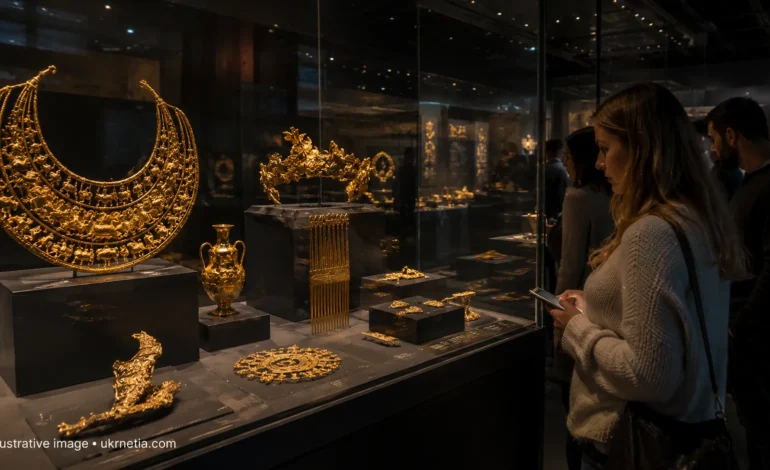
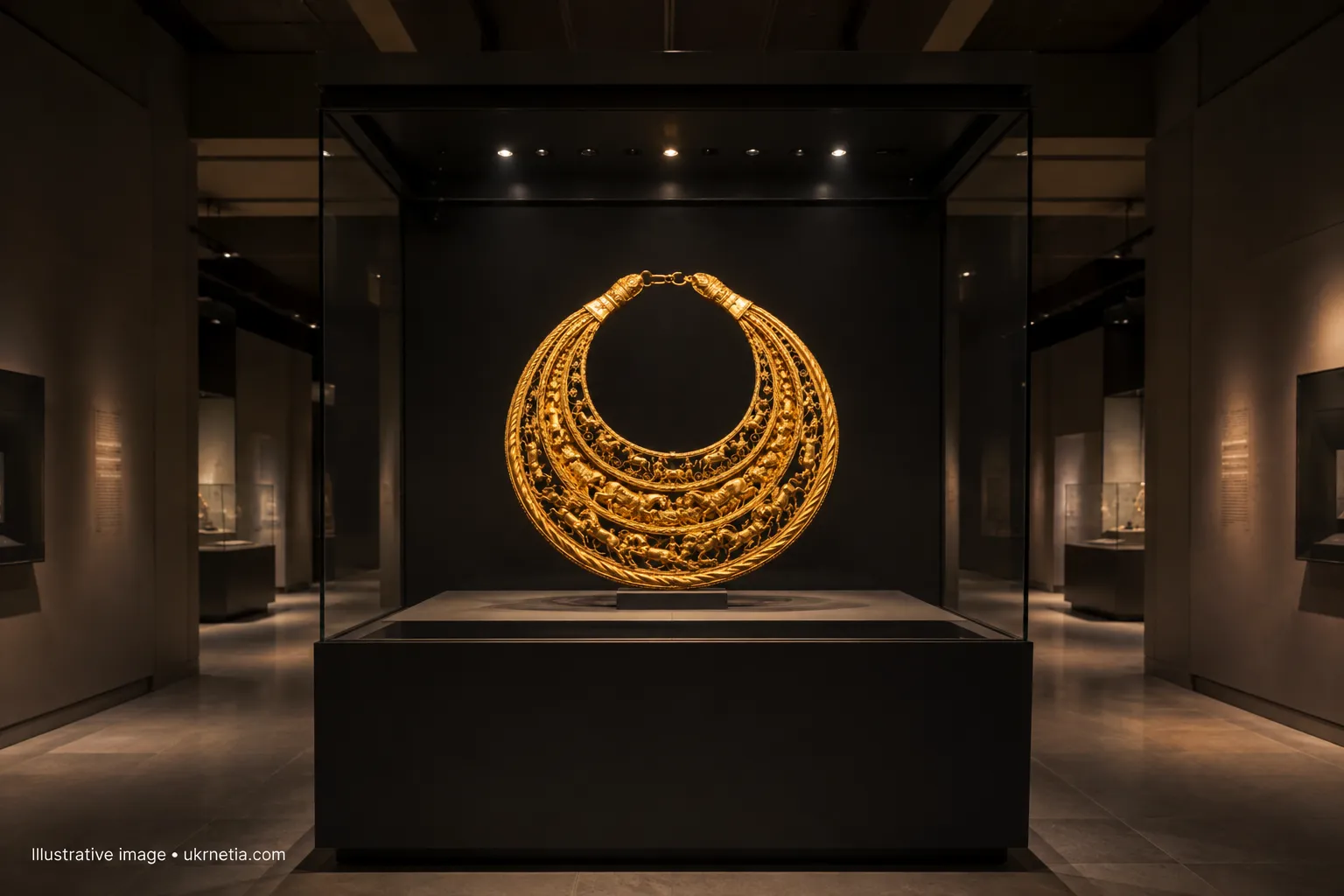
Today, it is preserved in the Museum of Historical Treasures of Ukraine, a branch of the National Museum of the History of Ukraine in Kyiv. There, the pectoral is displayed under carefully controlled conditions designed to protect its delicate goldwork from changes in temperature, humidity, and light.
For visitors, seeing the artifact in person is often a surprising experience.
Photographs capture its beauty.
Standing before it reveals something else entirely—its extraordinary scale, the astonishing precision of its miniature figures, and the realization that every detail was created more than twenty-three centuries ago without modern tools.
The museum places the pectoral alongside other masterpieces of Scythian gold, allowing visitors to understand that it was not an isolated work of genius but part of a broader artistic tradition that flourished across the northern Black Sea region.
Together, these objects help tell the story of a civilization that expressed its identity not through monumental stone architecture, but through portable works of exceptional craftsmanship.

Why the Golden Pectoral Still Matters
More than two millennia have passed since the pectoral was placed inside a royal burial mound.
Yet it continues to ask questions that remain surprisingly modern.
How do civilizations express power?
How do cultures influence one another?
What survives after kingdoms disappear?
For historians, the Golden Pectoral is valuable because it preserves evidence that written sources alone could never provide.
For archaeologists, it demonstrates how a single discovery can transform an entire field of research.
For art historians, it represents one of antiquity’s finest achievements in goldsmithing.
And for museum visitors, it offers something more personal: a direct encounter with people who lived more than twenty-three centuries ago, yet celebrated beauty, craftsmanship, family, animals, and the natural world in ways that still feel remarkably familiar.
The pectoral reminds us that ancient societies cannot be reduced to simple stereotypes.
The Scythians were renowned horsemen and formidable warriors.
But they were also patrons of extraordinary art, participants in long-distance trade, and members of a sophisticated cultural world stretching from the Eurasian steppe to the Greek cities of the Black Sea.
Conclusion
Some archaeological discoveries rewrite history because they uncover lost civilizations.
Others do so because they change how we see civilizations we thought we already understood.
The Scythian Golden Pectoral belongs firmly to the second category.
Discovered beneath a quiet burial mound in southern Ukraine, it transformed the image of the Scythians from a people remembered primarily through ancient Greek descriptions into a culture whose artistic sophistication speaks for itself.
Its gold may capture the eye.
Its craftsmanship inspires admiration.
But its greatest contribution lies elsewhere.
It reminds us that the past is rarely as simple as the stories handed down through history.
Every excavation has the potential to reveal forgotten connections.
Every artifact preserves voices that were never written down.
And every generation of archaeologists returns to discoveries like the Golden Pectoral with new questions, new technologies, and new perspectives.
That is why this remarkable object continues to matter.
Not because it is made of gold.
But because it continues to tell a story that history has not yet finished reading.
📚 Key Takeaways
- The Scythian Golden Pectoral was discovered in 1971 at the Tovsta Mohyla burial mound in southern Ukraine.
- It is one of the finest surviving masterpieces of ancient goldsmithing from the Eurasian steppe.
- The artifact dates to the 4th century BCE and is associated with the Scythian ruling elite.
- Its three decorative registers depict human life, vegetation, and dynamic animal scenes.
- Most scholars interpret it as a ceremonial object rather than everyday jewelry.
- The pectoral reflects close cultural interaction between the Scythians and the Greek cities of the northern Black Sea.
- Its imagery continues to be studied because the Scythians left very few written records.
- Today it is preserved in Kyiv, where it remains one of Ukraine’s most significant archaeological treasures.