
Ukraine’s Research Icebreaker Noosphere Prepares for Its Sixth Antarctic Season

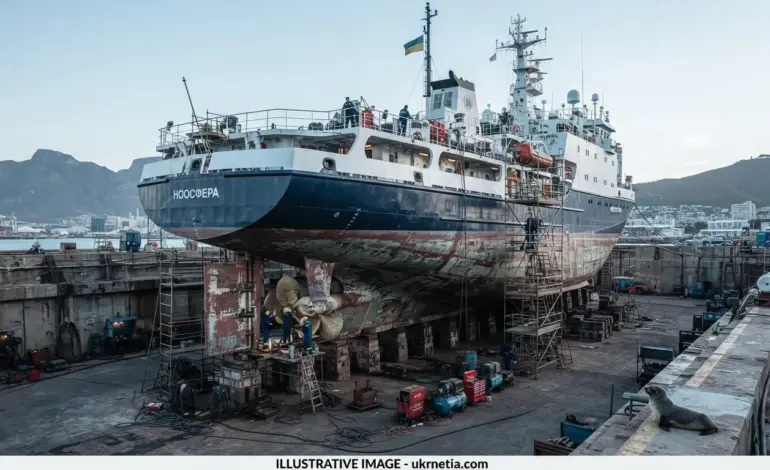

- Ukraine’s research icebreaker Noosphere is undergoing scheduled maintenance in a dry dock in Cape Town before its sixth Antarctic season.
- The almost 6,000-ton vessel is having its underwater hull cleaned and repainted, while its propeller and other systems are being serviced.
- The ship’s navigation equipment is also being upgraded with modern echo sounders for more accurate depth measurements and seabed mapping.
- Engineers are inspecting the main and auxiliary machinery to prepare the vessel for extended operations.
- Noosphere has operated under the Ukrainian flag since its first voyage in January 2022, shortly before Russia’s full-scale invasion.
- Since then, it has transported Ukrainian polar researchers and supplies to Akademik Vernadsky Station, supported other Antarctic stations and participated in Southern Ocean research.
- The previous Antarctic season was a record one, with nine Antarctic voyages and 18 crossings of the Drake Passage.
Ukraine’s research icebreaker Noosphere is undergoing scheduled maintenance in Cape Town, South Africa, as preparations begin for its sixth Antarctic season.
The nearly 6,000-ton research vessel is currently in a dry dock, where engineers are carrying out maintenance on its hull, propulsion system, machinery and navigation equipment. The work is intended to prepare the ship for another extended period of operations in Antarctic waters.
For Ukraine, Noosphere is much more than a transport vessel. It has become an important part of the country’s scientific infrastructure, carrying researchers and supplies to Antarctica while also serving as a platform for oceanographic research.
Why the Ship Is in Cape Town
Noosphere is based in Cape Town between its Antarctic missions.
Because Russia’s full-scale invasion made it impossible for the vessel to return to its home port of Odesa, Cape Town has become its operational base between expeditions.
From there, the vessel begins its long voyages toward Antarctica, including trips to Ukraine’s Akademik Vernadsky Antarctic Station.
The Cape Town dry dock therefore plays an important role in keeping the Ukrainian research fleet operational.
The Hull Is Being Cleaned and Repainted
One of the main tasks during the current maintenance period is work on the underwater part of the ship.
Engineers are cleaning and repainting the hull while also inspecting components that remain below the waterline during normal operations.
The work is essential for a vessel that spends long periods at sea and operates in demanding conditions.
The Propeller and Other Underwater Systems Are Being Serviced
Technicians are also servicing the propeller, bottom fittings and other elements of the ship’s underwater systems.
These components are particularly important for a research vessel that must travel thousands of kilometers between South Africa and Antarctica.
A failure in the propulsion system during an Antarctic voyage could be extremely difficult to deal with, making preventive maintenance essential.
Navigation Equipment Is Being Upgraded
Noosphere is also receiving new navigation equipment.
Modern echo sounders will be installed to allow the crew and researchers to determine water depth more accurately and monitor the shape of the seabed.
This equipment has both practical and scientific value.
What Is an Echo Sounder?
An echo sounder sends sound signals through the water and measures the time required for the signal to return from the seabed.
The resulting measurements allow researchers and navigators to determine water depth and construct information about underwater terrain.
For an oceanographic research vessel, this is an important capability.
Engineers Are Also Inspecting the Engine Room
Maintenance is not limited to the outside of the vessel.
In the engine room, specialists are inspecting the main and auxiliary machinery, systems and other equipment.
The goal is to make sure that the ship is ready for prolonged operation during the next Antarctic season.
A Research Vessel Built for Long Voyages
Noosphere has to operate far from conventional infrastructure.
Once it leaves Cape Town for Antarctica, the vessel can spend significant periods at sea before returning to port.
That makes reliability particularly important.
Routine maintenance before each season is therefore a major part of the Antarctic programme.
Noosphere’s First Voyage Under the Ukrainian Flag
The vessel made its first voyage under the Ukrainian flag in January 2022.
That happened only about a month before Russia launched its full-scale invasion of Ukraine.
Since then, the ship has operated almost continuously as part of Ukraine’s Antarctic programme.
The Ship Became Ukraine’s Antarctic Lifeline
Noosphere transports polar researchers, equipment and supplies to Akademik Vernadsky Station.
It also supports logistical operations involving other Antarctic research stations.
This role is essential because the Ukrainian station is located thousands of kilometers from Ukraine.
It Also Carries Out Scientific Research
The ship is not simply a supply vessel.
Researchers use Noosphere as a platform for scientific work in the Southern Ocean.
Its research programme can include oceanographic, geological, biological and other environmental studies.
The Fifth Antarctic Season Was a Record
Noosphere completed its fifth Antarctic season in May 2026.
According to the National Antarctic Scientific Center, the season lasted more than seven months and included a record nine voyages to Antarctica.
The ship also crossed the Drake Passage 18 times.
More Than 56,000 Kilometers at Sea
During that fifth season, Noosphere travelled more than 30,000 nautical miles, equivalent to more than 56,000 kilometers.
That distance is greater than the circumference of Earth at the equator.
The numbers demonstrate how heavily the vessel is being used by the Ukrainian Antarctic programme.
The Drake Passage Is One of the World’s Roughest Seas
The Drake Passage separates the southern tip of South America from the Antarctic Peninsula.
It is notorious for powerful winds and large waves.
Noosphere crossed it 18 times during its fifth season, making the reliability of the vessel and its crew particularly important.
The Fifth Season Also Expanded International Cooperation
Noosphere supported scientific and logistical cooperation involving several countries during its latest season.
According to the National Antarctic Scientific Center, Ukraine worked through the vessel and Akademik Vernadsky with partners including Poland, the Czech Republic, the United Kingdom, the United States, Canada, Colombia and Mexico.
Mexico Joined the Antarctic Programme
One of the notable developments during the fifth season was cooperation with the first Mexican Antarctic expedition.
Noosphere and Akademik Vernadsky provided platforms for the Mexican researchers’ work.
The cooperation expanded Ukraine’s international scientific connections without requiring a separate research infrastructure for every participating country.
Ukraine’s Antarctic Programme Is International
Although Noosphere is a Ukrainian vessel and Akademik Vernadsky is Ukraine’s Antarctic station, the programme increasingly involves scientists and institutions from other countries.
That makes Ukraine’s Antarctic presence part of a wider international research network.
Why Antarctic Research Matters
Antarctica plays an important role in the global climate system.
Changes in Antarctic ice, ocean temperatures, marine ecosystems and atmospheric conditions can influence processes far beyond the continent itself.
Research in the Southern Ocean therefore contributes to understanding global environmental change.
The Southern Ocean Is a Major Research Area
The waters surrounding Antarctica are important for ocean circulation and the global climate system.
They also contain complex ecosystems, from microscopic organisms to whales and other large marine animals.
Scientific observations from research vessels such as Noosphere help scientists understand how these systems are changing.
Noosphere Has a Long Scientific Heritage
The vessel has a history as an international research platform extending well beyond Ukraine’s current Antarctic programme.
The National Antarctic Scientific Center notes that the ship spent decades serving as a platform for biological, oceanographic and geophysical research.
Its current Ukrainian mission builds on that scientific tradition.
Research Continues Despite the War
Russia’s full-scale invasion has created major difficulties for Ukrainian scientific institutions.
Yet the Antarctic programme has continued.
Noosphere has remained operational, while Ukrainian researchers continue to work at Akademik Vernadsky and conduct scientific projects in Antarctica and the Southern Ocean.
Cape Town Has Become an Important Base for Ukraine
The choice of Cape Town as Noosphere’s base reflects the practical consequences of the war.
The vessel cannot currently return to Odesa, so South Africa has become the logistical starting point for its Antarctic missions.
This arrangement allows Ukraine to maintain its Antarctic programme despite the security situation in the Black Sea.
The Current Maintenance Is Part of Long-Term Planning
The work being carried out now is not an emergency repair.
It is scheduled maintenance designed to ensure that Noosphere can safely complete another demanding Antarctic season.
The hull, propulsion systems, navigation equipment and machinery are all being checked before departure.
A Small Visitor Has Become Part of the Story
The technical team has even attracted an unexpected observer.
A fur seal has appeared near the dry dock while maintenance work is underway.
The National Antarctic Scientific Center jokingly described the animal as an “inspector” monitoring the work.
The unusual visitor has added a lighter detail to an otherwise highly technical maintenance operation.
The Ship’s Next Mission Will Combine Logistics and Research
When Noosphere enters its sixth Antarctic season, its tasks will again extend beyond transportation.
The vessel is expected to deliver researchers and supplies, support the rotation of personnel at Akademik Vernadsky and participate in scientific work.
The New Echo Sounders Could Benefit Research
The upgraded echo sounders will improve the vessel’s ability to measure depth and monitor seabed relief.
That information can be useful both for safe navigation and for scientific studies of the ocean floor.
Seabed Research Can Reveal Earth’s History
Marine sediments contain information about geological and environmental processes that took place over long periods.
Scientists can study these sediments to investigate changes in climate, ecosystems and geological conditions.
Noosphere has already supported geological research in the Southern Ocean during previous seasons.
The Ship Also Supports Other Antarctic Stations
Noosphere does not serve only Ukraine’s Akademik Vernadsky Station.
Its logistical capabilities have also supported other Antarctic stations and international research programmes.
This makes the vessel a useful shared platform for international Antarctic science.
Its Role Has Grown Since 2022
Noosphere began operating under the Ukrainian flag just before the full-scale invasion.
Since then, its importance has increased because Ukraine has had to maintain its Antarctic programme under extraordinary conditions.
The ship has effectively become the maritime link connecting Ukraine’s Antarctic scientific work with the rest of the world.
Why the Vessel Matters to Ukraine
Scientific infrastructure can be easy to overlook during wartime.
But maintaining research capacity matters for Ukraine’s long-term scientific development and international cooperation.
Noosphere allows Ukrainian scientists to remain active in a field where continuous international participation is essential.
Antarctica Is Also a Diplomatic Space
Scientific cooperation in Antarctica involves countries that may have very different political interests.
Research programmes provide opportunities for collaboration around shared scientific questions.
Ukraine’s continued participation therefore has importance beyond individual experiments.
Noosphere Connects Ukraine With Global Science
The vessel has supported partnerships involving researchers from Europe, North America and Latin America.
The fifth season alone involved cooperation with seven foreign countries, according to the National Antarctic Scientific Center.
That makes the ship one of Ukraine’s most visible platforms for international scientific cooperation.
Preparing for Another Long Season
Before the vessel can return to Antarctica, engineers must complete the current maintenance programme.
The dry-dock work includes cleaning, painting, mechanical inspections and navigation upgrades.
Once the work is complete, Noosphere will be ready to leave Cape Town for another Antarctic mission.
A Ship That Keeps Ukraine in Antarctica
The story of Noosphere is closely connected with Ukraine’s determination to maintain its Antarctic scientific programme despite the war.
The vessel cannot currently operate from Odesa, but it continues to sail from Cape Town.
It continues to transport scientists, deliver supplies and participate in research.
The Sixth Season Is Now Ahead
The current maintenance programme marks the transition between the fifth and sixth Antarctic seasons.
After a record-breaking previous season, the ship is being prepared for another demanding period of operations.
Its new navigation equipment and serviced machinery should help it continue working in some of the most challenging waters on Earth.
What Happens Next
Engineers will complete the scheduled maintenance and prepare Noosphere for departure from Cape Town.
The sixth Antarctic season will then bring another cycle of logistics, scientific research and international cooperation.
For Ukraine, the mission will once again mean maintaining a permanent scientific presence in Antarctica despite the extraordinary circumstances created by Russia’s war.
A Ukrainian Flag in the Southern Ocean
Noosphere’s story is ultimately about continuity.
A Ukrainian research vessel is operating thousands of kilometers from home, maintaining scientific links with international partners while supporting the country’s Antarctic station.
As the ship receives its final maintenance before the sixth season, Ukraine’s Antarctic programme is preparing to continue its work — one voyage, one research mission and one difficult ocean crossing at a time.